



How Are Large Custom Chandeliers Packed for Overseas Hotel Projects?

Zoey
Lighting Designer
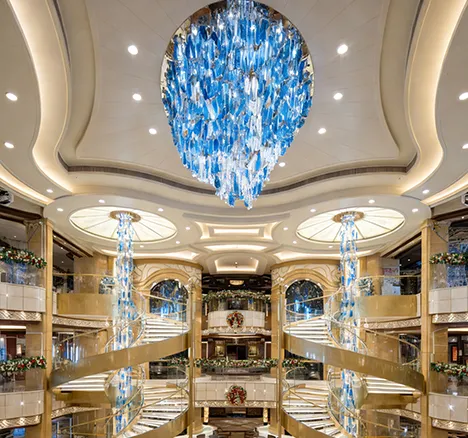
A chandelier that looks complete in a factory photograph is rarely shipped as one complete object. For an overseas hotel project, a large chandelier may combine a metal canopy, structural frames, suspension cables, drivers, hundreds of glass or crystal elements, fasteners, tools and spare parts. Each group responds differently to vibration, compression, moisture and handling. Safe delivery therefore depends on a packaging system designed together with the fixture, not on adding a wooden box after production.
Effective custom chandelier packaging has two jobs. It must prevent damage during inland transport, container loading, sea or air freight and final delivery. It must also preserve the information needed to rebuild the approved design at the hotel. The best packing plan connects engineering drawings, module numbers, crate labels, packing lists and the installation sequence into one controlled system. For coordinated deliveries at property scale, see Cuslux large hotel projects.
Plan Custom Chandelier Packaging During Engineering

Packaging decisions should begin while the custom chandelier is being engineered. The design team must identify which parts can travel assembled, which parts must be removed, and where temporary transport supports are required. Waiting until the fixture is finished may reveal that a frame is too large for a container door, a canopy cannot pass through the hotel lift, or a decorative element has no safe contact point for cushioning.
The packing engineer should review the fixture envelope, module dimensions and weights against the selected transport route. The review must include factory doorways, truck and container limits, destination unloading equipment, hotel loading-bay access, lifts, corridors and the final assembly area. These checks can influence canopy segmentation, connector positions, cable plugs and the maximum size of a rigid frame.
This is also when responsibilities should be fixed. The custom lighting manufacturer can provide crate sizes, weights, lifting points and unpacking instructions, while the freight forwarder and hotel contractor confirm route limitations, import requirements and site handling. A written packing basis prevents late improvisation.
Divide Large Custom Chandeliers into Transportable Modules
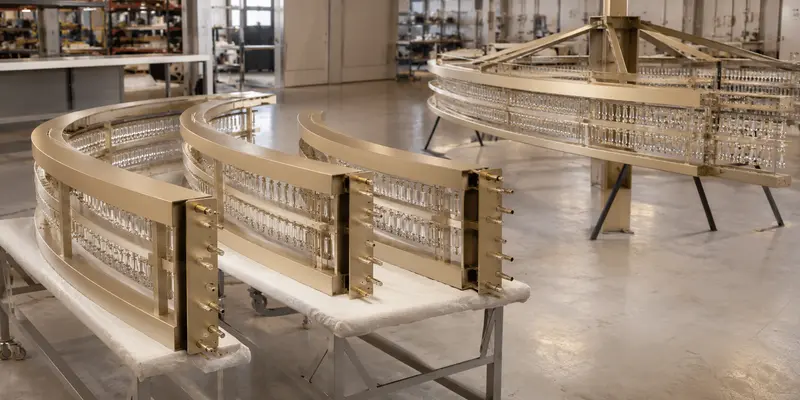
Large custom chandeliers are normally divided into stable, repeatable modules. A long canopy may be separated into numbered sections; curved metalwork may use hidden bolted joints; electrical circuits may terminate at labeled connectors; and delicate ornaments may remain completely separate until installation. The objective is not to create the greatest number of small parts, but to create the fewest modules that can be handled safely without losing alignment.
Every split must respect both structure and appearance. Connection points are preferably placed where they are visually discreet and mechanically accessible. Alignment holes, sleeves, flanges or locating pins help the installer reproduce the factory geometry. Adjacent modules should be trial assembled before finishing or dispatch, then kept as matched sets. For free-form or wave-shaped chandeliers, module order is especially important because two similar-looking sections may have different curvature.
Transport frames should support each module at approved structural zones rather than at decorative edges, diffusers or thin finished surfaces. If a long frame can flex, a shaped wooden or metal support is more useful than loose cushioning because it holds the intended geometry throughout transport.
Pack Crystal and Glass Chandelier Components Separately

Crystal drops, blown-glass pieces and decorative glass panels should generally not remain mounted on the main frame during overseas chandelier shipping. Road vibration and container movement can make adjacent pieces strike one another, while the weight of hanging ornaments can overload small pins or cables. Separating them also protects the metal finish from abrasion. To see how these individual pieces are arranged in the finished fixture, read how glass pieces are arranged in a custom chandelier.
For crystal chandelier packaging, each piece or small controlled group should receive non-abrasive contact protection and a fitted cavity, divider or sleeve that prevents movement. Heavy pieces should not be stacked on lighter ornaments. Irregular handmade glass needs support around strong areas rather than pressure on thin rims or artistic projections. The inner carton then sits within a stronger outer carton or crate with sufficient restraint to stop shifting.
Protection must be clean and chemically compatible with the surface. Tape should not touch glass coatings, plated metal or painted finishes. Soft film can prevent scratches, but it cannot replace structural blocking. The packaging standard should reflect the real weight, fragility and geometry of each component instead of applying one generic foam thickness to every item.
Protect Custom Chandelier Metal Frames and Finishes

Metal frames are less fragile than glass, but they can still arrive unusable if they are bent, scratched or stained. Brushed brass, plated finishes and dark polished coatings reveal small abrasions under hotel lighting. Each finished face should therefore be isolated from hard supports, fasteners and neighboring modules. Removable protective film, soft wrap and clean spacers are useful when approved for the finish. For how finish standards themselves are controlled, see hotel lighting finish consistency control.
Structural blocking must prevent the frame from sliding or twisting inside the crate. Blocks should contact robust frame members and distribute load; they should not clamp thin rings, cable outlets or ornamental leaves. Projecting arms and connection tabs may require individual guards. Loose hardware must be bagged, identified and secured so it cannot become a moving impact object.
Before packing, the surface should be dry and free of fingerprints, grinding dust and workshop residue. Photographs taken after protection and before the crate closes create evidence of condition and show the receiver how the module was supported.
Use Export Wooden Crates for Large Chandelier Packing
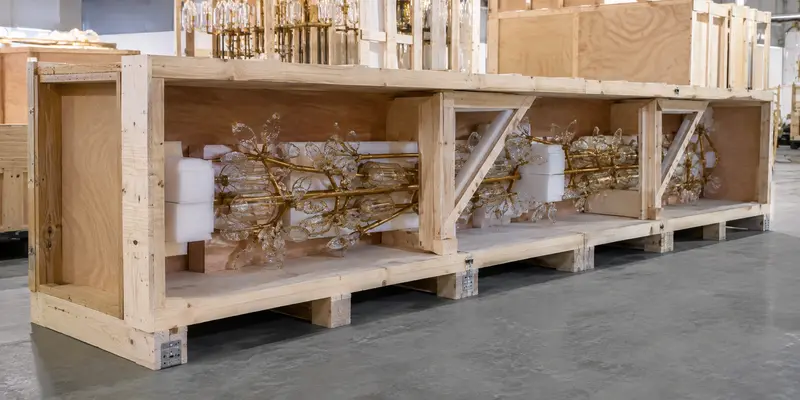
An export wooden crate provides rigidity, stack protection and defined lifting points for large chandelier packing. The crate should be engineered for the actual module weight and load path, with a base that can be handled by the planned forklift or lifting equipment. Internal frames, cleats and shaped supports immobilize the product; the outer shell alone does not protect a chandelier if the contents can move.
Crate dimensions should balance protection and logistics. Excessive empty space increases freight volume and gives components room to accelerate during impact, while an overly tight crate transfers external loads directly to the fixture. Fragile cartons and heavy frame modules should not share a crate unless they are separated by a load-bearing partition.
When raw solid-wood packaging material is used in international trade, ISPM 15 treatment and marking may apply. Processed wood products such as plywood are addressed differently by the standard, but destination-country rules and carrier requirements still need confirmation. The project team should verify the required wood type, treatment evidence and import documentation before crating, rather than assuming every wooden package follows the same rule.
Control Moisture in Overseas Chandelier Shipping
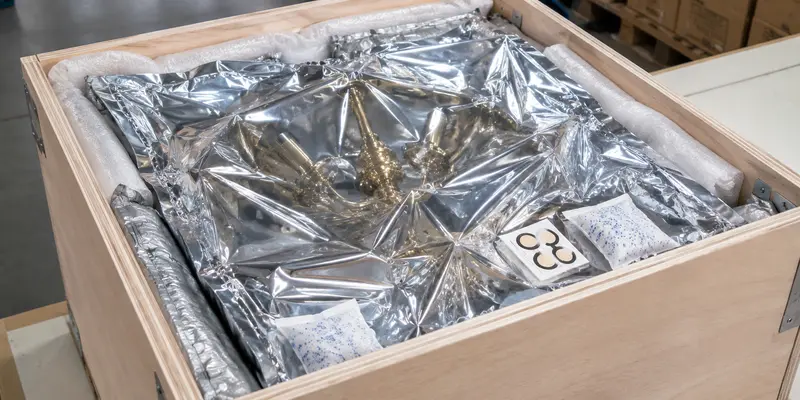
Sea freight can expose custom light fixtures to changing temperature and humidity for weeks. Condensation may form inside containers even when the cargo never contacts rain. Metal parts can corrode, cartons can soften, labels can detach and some surface finishes can discolor. Moisture control therefore begins with packing only clean, fully cured and dry components.
Depending on the route and product, the packing plan may use sealed barrier bags, desiccant, humidity indicators, corrosion-inhibiting materials or a combination of these measures. Desiccant quantity and barrier performance should be sized for the package volume, transit duration and expected climate; adding a few uncalculated sachets is not a moisture-control design. Materials must also be kept away from optical and decorative surfaces if there is any risk of residue.
Crates should be stored under cover before loading and after arrival. If the destination has a major climate change, the receiver may need to allow sealed components to acclimatize before opening them, reducing immediate condensation on cold surfaces.
Connect Chandelier Packaging Numbers to Installation Drawings
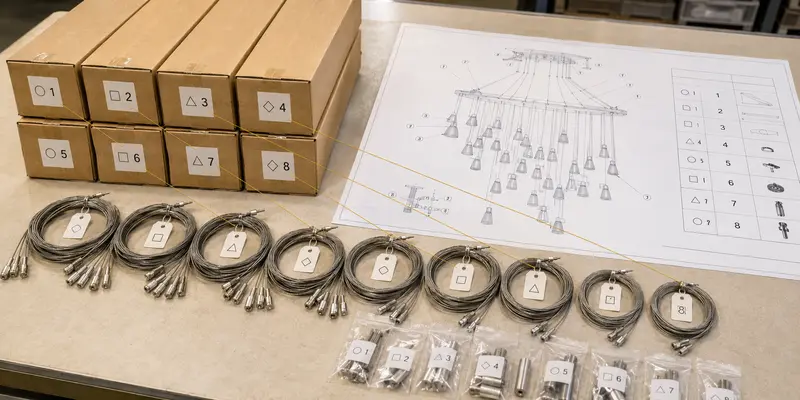
Numbering is the bridge between custom chandelier packaging and final appearance. Every crate, carton, module and repeated decorative component should carry a code that matches the packing list and installation drawing. A label such as “glass” is insufficient when hundreds of similar pieces have different lengths, colors or locations.
A practical code can identify fixture, zone, module and component position. The same code should appear on the shop drawing, suspension schedule, carton label and spare-parts list. Labels must remain readable after handling, and a duplicate list should be available digitally so installation does not stop if one paper copy is damaged.
The manufacturer should avoid creating separate numbering systems for production, packing and installation. Translation between three systems introduces errors. One controlled code structure lets the hotel team trace a missing item back to its carton and lets the factory identify the correct replacement without relying on photographs alone.
Arrange Custom Hotel Lighting Packing by Installation Sequence
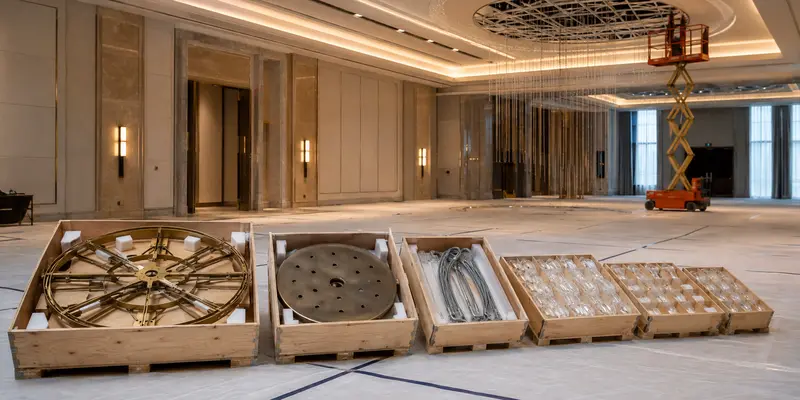
For custom hotel lighting, the order in which crates are opened can be as important as the protection inside them. If decorative glass arrives in the first accessible crate but the ceiling canopy is buried behind other cargo, the site must unpack and store fragile parts before they are needed. This increases handling and damage risk.
Where loading conditions allow, packing should follow the installation sequence: structural support and canopy modules first, electrical equipment and suspension parts next, then decorative components by zone. Crate labels can state the installation stage, hotel area and opening priority. A consolidated packing plan should also show which crates must remain closed until the site is clean and ready. For how large fixtures are engineered for safe installation, see how large custom hotel chandeliers are engineered for safe installation.
The plan must consider site storage. Ballrooms and lobbies often have limited protected space while other trades are working. Smaller staged deliveries may be safer than unloading the entire chandelier at once, but they require coordination with customs, transport and the installation program.
Prepare Chandelier Spare Parts and Installation Kits
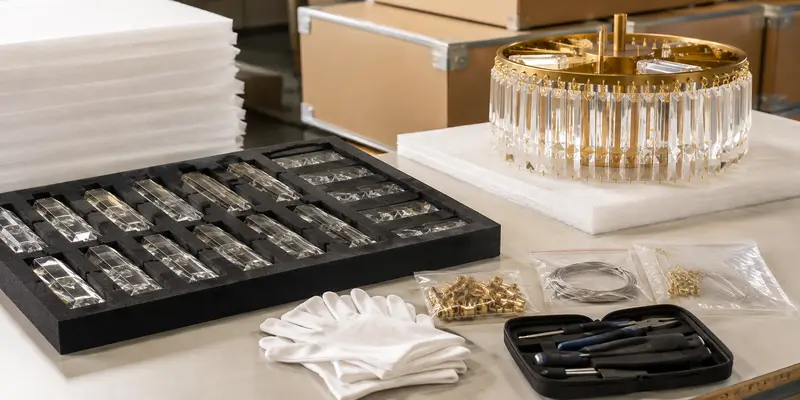
A controlled quantity of chandelier spare parts reduces the risk that one damaged ornament delays completion. Fragile glass or crystal pieces, special connectors, suspension wires, LEDs or drivers may justify spares, but the quantity should reflect component value, breakage risk, replacement lead time and the hotel maintenance plan.
Spares should be clearly separated from production quantities and labeled with the same component codes. They need equal protection; loose spare glass placed in a general hardware box is not useful. For handcrafted materials with natural variation, the manufacturer should select spares from the same production batch where possible so color and texture remain compatible.
Installation kits should group approved fasteners, safety cables, connectors, gloves and special tools by module or work stage. Site-supplied anchors and structural fixings must be distinguished from manufacturer-supplied parts. This prevents installers from substituting an unverified item because a bag cannot be found.
Inspect Custom Chandelier Packaging Before Dispatch

Packing quality should be inspected as a production deliverable, not treated as a warehouse formality. The check begins by confirming that the latest approved fixture, quantities and revisions are present. Inspectors then verify component protection, immobilization, matched module numbers, accessories, spare parts, labels, crate condition and required export markings.
A controlled pre-dispatch record should include photographs of critical layers: the bare approved component, surface protection, internal supports, sealed cartons, crate interior before closing and final external labels. For a complex one-off chandelier, a packing witness or video review may be appropriate. These records assist receiving inspection and clarify whether later damage occurred before or after dispatch.
The gross weight, net weight, center of gravity where relevant, lifting position and “do not stack” limitations should be accurate. A symbol cannot compensate for a crate that is structurally unable to survive normal handling, but clear handling marks help carriers apply the intended method.
Receive and Unpack Custom Hotel Lighting at the Hotel Site

Safe chandelier shipping ends only after controlled receiving. The hotel contractor should compare crate numbers and visible condition with the packing list before signing receipt. Impact, water exposure, broken panels or abnormal tilt should be photographed immediately, and the agreed notification procedure should be followed before evidence is lost.
Crates should be moved to a clean, dry and secure area using the marked lifting points. The unpacking team should read the sequence and support instructions before removing internal braces; a long curved module may deform if its transport support is released while the frame is held incorrectly. Glass and crystal cartons should stay closed until their installation zone is ready.
As cartons are opened, quantities and codes should be checked against the drawings. Protective materials and temporary supports should not be discarded until the related module has been assembled and accepted. A controlled receiving process preserves traceability and makes any replacement request faster and more precise.
Large Custom Chandelier Packaging Checklist
The following release check converts the packing plan into evidence that procurement, logistics and installation teams can verify before dispatch.
| Control point | Required evidence | Release question |
|---|---|---|
| Engineering split | Approved module and connector drawings | Module sizes suit route and site access |
| Fragile components | Piece codes and fitted protection | No glass-to-glass or glass-to-metal contact |
| Frames and finishes | Protected faces and structural blocking | No load on decorative projections |
| Crates | Crate drawings, dimensions and weights | Handling points and internal restraints confirmed |
| Moisture control | Approved barrier/desiccant method | Parts packed clean, dry and fully cured |
| Export compliance | Required wood/material evidence | Destination and carrier requirements checked |
| Identification | Drawing, carton and crate code match | One numbering system used throughout |
| Installation sequence | Crate opening and zone plan | Loading order supports site workflow |
| Spares and kits | Coded spare-parts and hardware lists | Supplied and site-supplied items separated |
| Final inspection | Photos, packing list and dispatch record | Quantity, condition and labels approved |
FAQ About Custom Chandelier Packaging
Can a large custom chandelier be shipped fully assembled?
Usually not. Large canopies, frames and fragile ornaments are safer when separated into engineered modules. A small robust fixture may travel assembled, but the decision should follow a transport-risk and access review rather than convenience alone.
Should crystal and glass pieces be installed before chandelier shipping?
For large overseas projects, they are normally removed and individually protected. This prevents pieces from striking one another and reduces load on suspension pins, wires and finished frames.
Does every export wooden crate need an ISPM 15 mark?
Not every wood-based package is treated identically. ISPM 15 principally regulates specified raw solid-wood packaging material; processed wood products may be exempt under the standard. Confirm the actual material, destination-country rules and carrier requirements with the freight provider.
How can installers find the correct position for hundreds of chandelier pieces?
Use one code system across shop drawings, suspension schedules, cartons and component labels. The installation team should be able to locate every piece by code, not by visually guessing among similar ornaments.
How many chandelier spare parts should be packed?
There is no universal percentage. Set the quantity by fragility, total piece count, replacement lead time, batch variation and the hotel maintenance strategy. List and protect spares separately.
Make Custom Chandelier Packaging Part of Hotel Project Delivery
Successful custom chandelier packaging protects more than the product. It preserves geometry, finish quality, component identity and the intended installation sequence from the factory to the hotel ceiling. That requires early module planning, separate protection for fragile materials, engineered internal restraints, moisture control, coordinated labeling and documented inspection.
Before approving production, review the full custom hotel lighting pre-production checklist. For tall atriums or multi-level spaces, see how to customize a long chandelier for a hotel staircase or atrium. Procurement teams can also review how hotel buyers can avoid delays and quality issues when choosing custom lighting.
For a packaging review, provide the latest shop drawings, module sizes and weights, quantities, fragile-material schedule, destination, transport method, hotel access restrictions and target installation sequence. Cuslux can use these details to plan the packing structure, numbering system, crate schedule and dispatch evidence together with the fixture engineering.