


What Should Be Confirmed Before Custom Hotel Lighting Production?

Zoey
Lighting Designer
A custom hotel lighting order should not enter production simply because a quotation, purchase order, or design rendering has been approved. Before materials are purchased and fabrication begins, the project team must confirm exactly what will be manufactured, how each fixture must perform, how it will be installed, and what evidence will be used for inspection.
This is especially important for large chandeliers, decorative pendants, wall lamps, guest-room fixtures, restaurant lighting, and coordinated lighting packages. A small unresolved detail—such as an incorrect canopy, an unapproved finish, or an incompatible driver—can affect hundreds of fixtures or delay an entire installation sequence.
The following checklist helps hotel owners, designers, contractors, procurement teams, and the custom lighting manufacturer establish one controlled production standard.
Confirm the Custom Hotel Lighting Scope and Design Intent
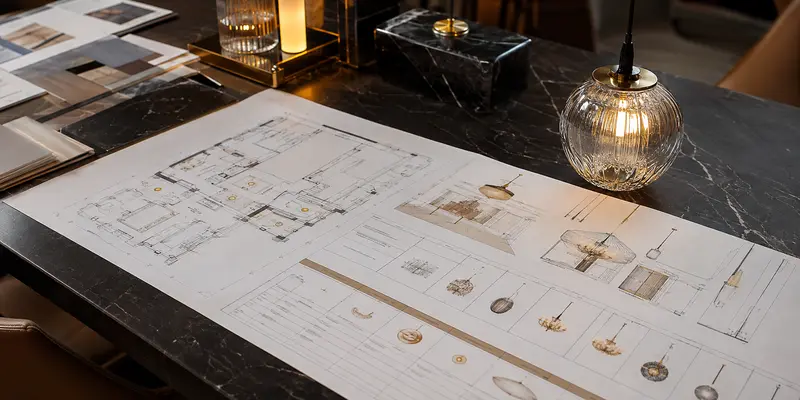
Start by confirming which fixtures are included in the custom hotel lighting package. Hotel projects often contain several revisions of the BOQ, room schedule, drawings, and quotations, so every fixture must be connected to one current source.
- Fixture code and product name
- Hotel area or room type
- Final quantity and dimensions
- Approved drawing number and revision
- Rendering or visual reference
- Sample approval status
- Installation location
- Items excluded or supplied by others
A rendering communicates appearance, but it does not fully define structure, tolerances, wiring, fixing, or maintenance access. Create a document register that identifies the latest approved files and clearly marks superseded revisions.
Approve Custom Lighting Shop Drawings and Site Dimensions
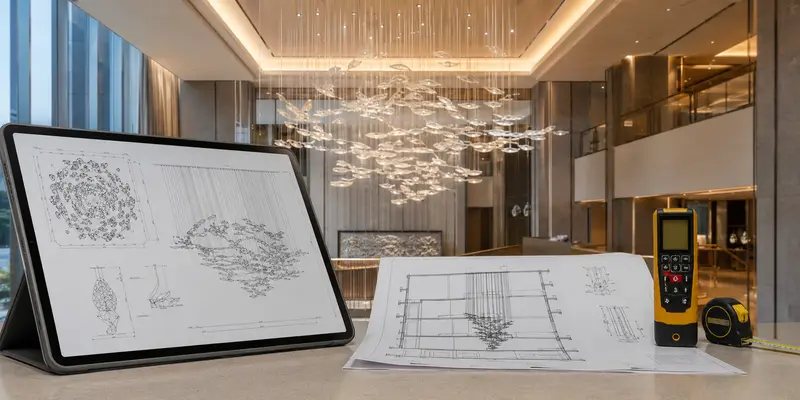
Custom lighting production should be based on approved shop drawings, not only on a concept image. The drawings should define overall dimensions, suspension length, mounting height, canopy size and finish, decorative element spacing, frame connections, wiring routes, light-source positions, assembly details, fixing points, component numbering, and maintenance access.
Site dimensions must be checked before release, particularly for staircase chandeliers, atrium lighting, and double-height spaces. The manufacturer can define the fixture and its fixing interface, while the local architect, engineer, or contractor confirms the ceiling condition, support structure, and verified site measurements. Any provisional dimension should remain visibly marked as open.
Lock Custom Chandelier Materials and Finish Samples

Descriptions such as “gold,” “clear glass,” or “brushed metal” are not precise enough for a custom chandelier. Confirm the metal base, plating or powder-coating process, glass color and texture, crystal specification, acrylic or resin, fabric, stone or ceramic components, cables, and all visible hardware.
Each approved sample should have a code, date, revision, and acceptable variation range. Handmade glass naturally varies, so the team should agree which differences are part of the intended craft character and which are defects. Evaluate finishes under representative project lighting; photographs support the record but should not replace a physical sample when color and texture are critical.
Confirm Hotel Lighting Electrical Specifications and Controls
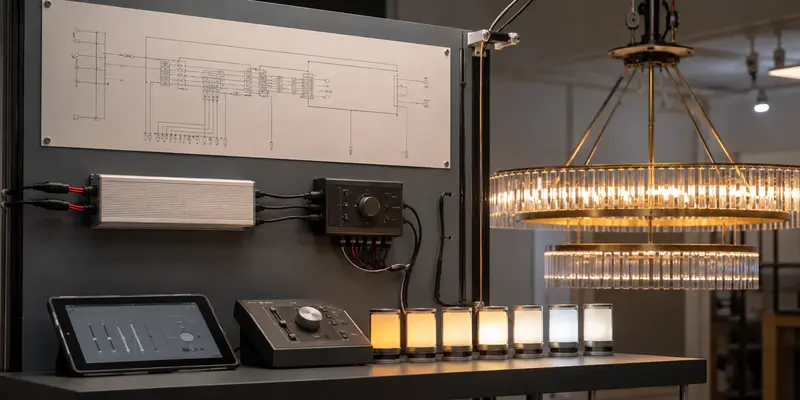
Electrical details must match the project design and destination market before components are ordered. Confirm voltage and frequency, lamp holder or LED module, wattage, lumen output, color temperature, CRI, driver model, dimming protocol, control zoning, emergency requirements, IP rating, connectors, and driver access.
For DALI, 0–10V, TRIAC, or other control systems, “dimmable” is not a complete specification. The driver, controller, load, and wiring method must be compatible. Large multi-module fixtures also require confirmed zoning and an accessible driver location.
Verify Custom Light Fixture Structure, Safety and Certification
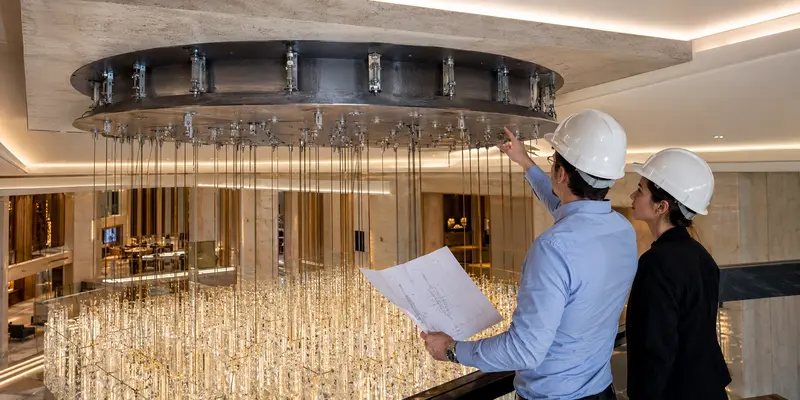
Large or irregular custom light fixtures require a structural review. A decorative ceiling must never be treated as the primary support. Confirm total and module weight, suspension points, load per point, cable or rod specification, secondary safety cables, ceiling interface, assembly and lifting method, safety factor, and responsibility for the building support.
The local engineer should verify loads and any seismic, vibration, or wind conditions. Certification requirements and the party responsible for each document should also be agreed before production because compliance can affect electrical components, construction methods, labels, and testing.
Approve a Bespoke Lighting Mock-Up or Production Sample
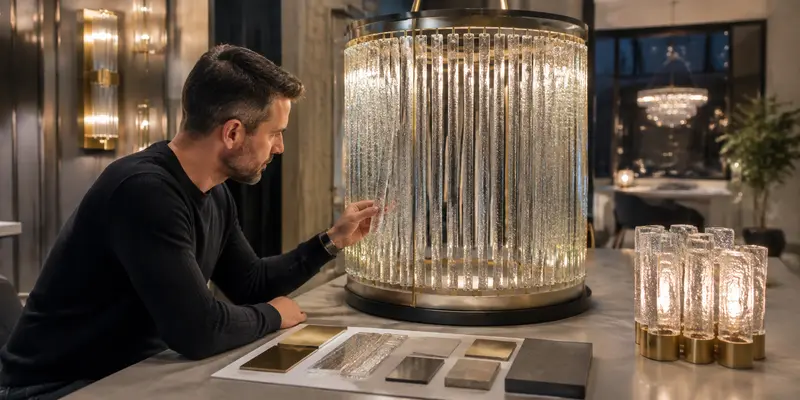
Not every bespoke lighting project needs a complete full-size prototype, but every project needs an approval method appropriate to its risk. This may be a complete repeated guest-room fixture, a chandelier module, a glass element, a material board, a canopy and suspension mock-up, a working LED and dimming sample, or a partial assembly.
Record exactly what the sample approves. A finish sample does not approve structure, and a working electrical sample does not automatically approve decorative color. The signed master sample should become a controlled reference for production and quality inspection.
Freeze Custom Lighting Quantities, BOQ and Commercial Terms
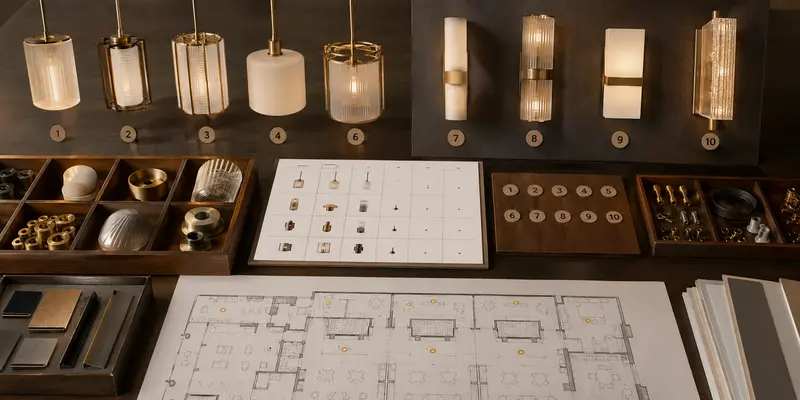
Freeze quantities by fixture code and reconcile the custom lighting BOQ with the purchase order. Include area allocation, approval samples, installation accessories, special tools, spare glass or crystal, spare drivers or LED modules, packaging units, and room or crate labels.
Commercial terms must cover the same scope: unit prices, deposit and balance, Incoterms, destination, warranty, installation or supervision, and agreed exclusions. Resolve every difference before release. The lead time should start from a clearly defined event, such as receipt of deposit plus complete technical approval.
Confirm Custom Hotel Lighting Packaging and Delivery
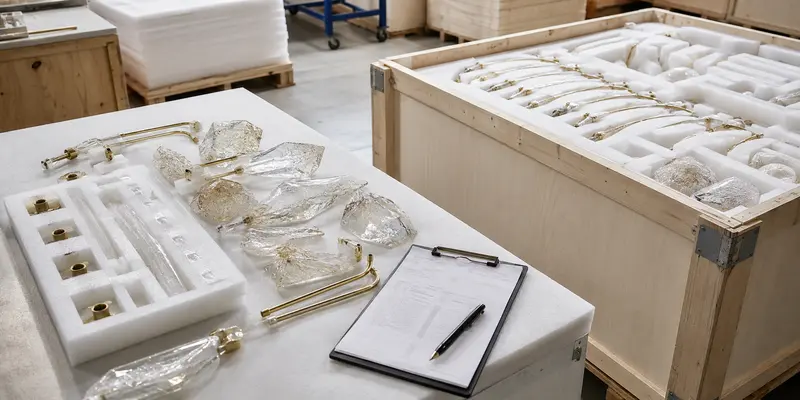
Packaging for custom hotel lighting should be designed around the fixture, transport route, storage conditions, and installation sequence. Confirm whether fixtures ship assembled or in modules, crate dimensions and weight, door and lift restrictions, protection against impact or moisture, fixture and room labels, packing lists, spare-part identification, pallet or fumigation requirements, and freight method.
Codes on drawings, packing lists, crates, components, and installation instructions should match. The receiving team also needs advance information about crate count, storage needs, fragile items, and unpacking order.
Plan Hotel Lighting Installation and Maintenance Access
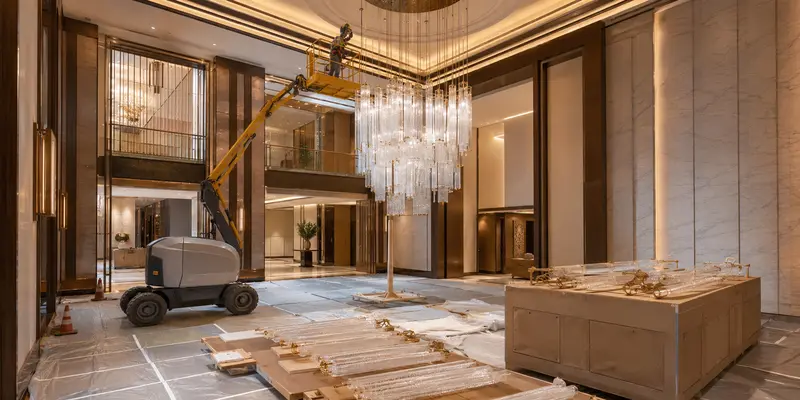
A fixture that can be manufactured but cannot be delivered, installed, adjusted, or serviced is not production-ready. Confirm installation responsibility, site readiness, structural supports, power and controls, scaffolding or lifting equipment, clean assembly space, maximum component size, installation sequence, testing, decorative adjustment, and final cleaning.
Drivers, LED modules, connectors, and replaceable parts should remain accessible. For long chandeliers in staircases and atriums, also define safe cleaning and maintenance methods before the suspension and assembly design is frozen.
Set Custom Lighting Quality Control and Production Release
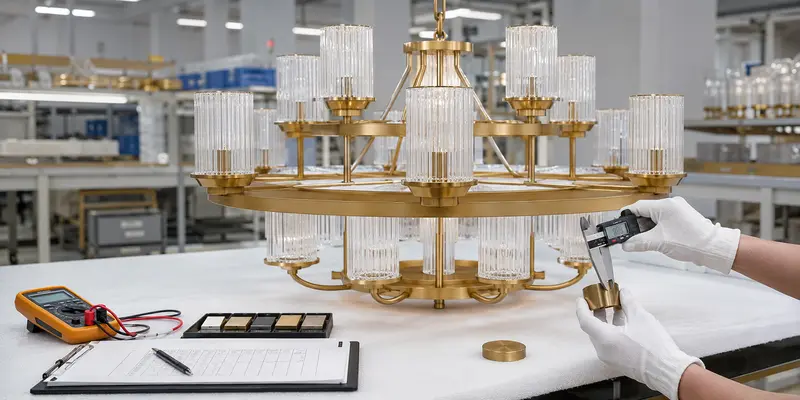
Custom lighting quality control needs measurable evidence rather than a general instruction to “match the sample.” The inspection plan should cover dimensions, finish, agreed color variation, quantity, alignment, welding, electrical continuity, grounding, LED operation, color temperature, dimming, assembly, surface defects, labels, and packaging.
Repeated fixtures may use an agreed sampling plan, while one-off feature chandeliers may require pre-assembly or a factory trial. The final production release should name every remaining open item, its owner, due date, and potential effect. Production begins only after an authorized approver signs the release file.
Custom Hotel Lighting Pre-Production Checklist
| Confirmation item | Required evidence | Status |
|---|---|---|
| Fixture scope and quantities | Approved BOQ and fixture schedule | Approved / Open |
| Final design | Approved rendering or reference | Approved / Open |
| Dimensions and structure | Signed shop drawings | Approved / Open |
| Site measurements | Verified site drawing or written confirmation | Approved / Open |
| Materials and finishes | Coded physical samples | Approved / Open |
| Electrical specification | Technical datasheet and wiring details | Approved / Open |
| Dimming and controls | Driver and protocol confirmation | Approved / Open |
| Certification | Agreed compliance requirements | Approved / Open |
| Sample or mock-up | Signed sample approval record | Approved / Open |
| Packaging | Packing method and labeling plan | Approved / Open |
| Installation | Installation drawing and responsibility matrix | Approved / Open |
| Quality control | Inspection checklist and tolerances | Approved / Open |
| Timeline | Approved production and delivery schedule | Approved / Open |
| Commercial terms | Confirmed PO and payment terms | Approved / Open |
FAQ About Custom Hotel Lighting Production
Can production begin after a rendering is approved?
Not usually. A rendering defines visual intent but normally does not confirm dimensions, construction, electrical components, fixing, tolerances, or installation details. Approved shop drawings and specifications are still required.
Is a full-size sample required for every fixture?
No. The approval method should match the risk. A repeated guest-room fixture may justify a complete sample, while a large custom chandelier may be approved through a module, material samples, a suspension mock-up, and technical drawings.
Who should approve custom lighting shop drawings?
Approval may involve the designer, owner or procurement team, contractor, and relevant technical consultants. The project must identify one authorized approver and a clear revision process.
What happens if the design changes after production release?
The change should be documented and reviewed for effects on materials, tooling, price, lead time, certification, and completed work. Informal instructions from conflicting channels should not replace a controlled change approval.
When does the custom lighting production lead time begin?
The trigger should be defined commercially. It commonly begins after the required deposit and all agreed drawings, samples, electrical details, and quantities have been approved.
How can sample-to-production differences be controlled?
Use a controlled master sample, approved drawings, finish references, agreed tolerances, and measurable inspection criteria. Production and quality teams should work from the same approved references.
Start Custom Hotel Lighting Production with a Signed Release File
The safest production decision is not that the design “looks finished,” but that the factory, inspector, logistics team, and installer are working from one complete file. Align the BOQ, drawings, materials, electrical specification, sample approvals, certification, packaging, installation, and quality plan before committing resources.
For related planning guidance, review our custom hotel lighting quote checklist and learn how a custom lighting manufacturer can work from a rendering.
To prepare a production review with Cuslux, send the fixture schedule, current drawings, verified dimensions, finish references, electrical requirements, quantities, destination, and target installation date. We can organize the technical file and identify the approvals still needed before production release.