


Factory Pre-Assembly vs On-Site Assembly for Large Chandeliers

Zoey
Lighting Designer
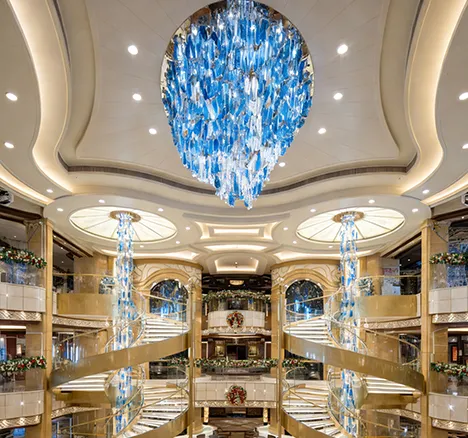
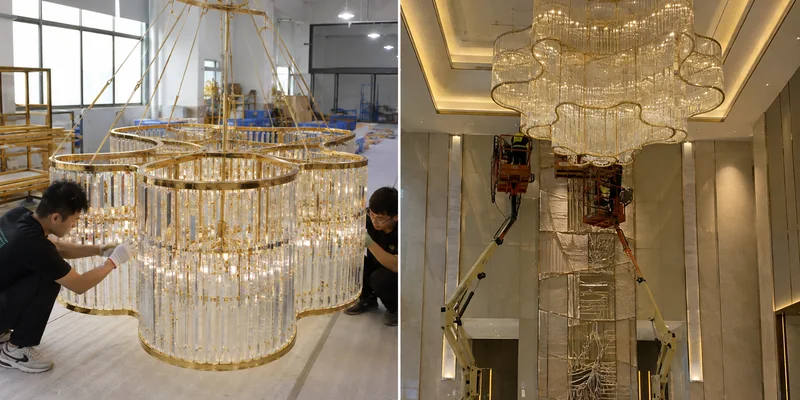
A large chandelier is rarely completed entirely in one place. The factory provides the controlled environment needed to verify structure, alignment, wiring and visual details. The hotel or commercial site provides the actual ceiling, access route, lifting conditions and final viewing distance. For that reason, factory pre-assembly and on-site assembly are not competing methods. They are two controlled stages of one custom chandelier installation strategy.
A fixture may appear complete during a factory trial and still need to be separated into canopy sections, structural modules, suspension cables and decorative components before shipping. At the destination, those parts are rebuilt around the real ceiling and adjusted to the architecture. The correct division of work depends on size, geometry, materials, transport limits, site access and installation risk.
Large Chandelier Assembly: The Quick Answer
Factory pre-assembly should complete as much work as can be usefully verified and then transported without damage. On-site assembly should complete the tasks that depend on the building: ceiling fixing, final suspension, module lifting, leveling, electrical connection and decorative adjustment.
A relatively compact custom chandelier may be fully assembled at the factory, electrically tested and temporarily fitted with glass or crystal. A multi-storey atrium chandelier may only allow the canopy, adjoining frame modules and a representative decorative zone to be trial assembled. The dependable approach is therefore not factory versus site, but factory verification followed by controlled site reconstruction.
What Chandelier Pre-Assembly Verifies at the Factory
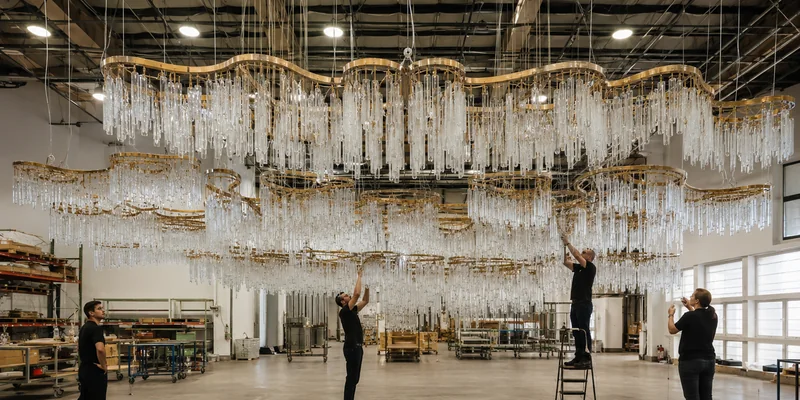
The purpose of chandelier pre-assembly is to convert drawings and individual parts into evidence that the design can be built. Shop drawings can define dimensions and connections, but they may not show whether a long frame remains level, whether two curved modules produce a continuous line, or whether decorative density looks balanced from below.
A trial can verify module fit, canopy alignment, frame dimensions, suspension positions, balance, wiring routes, connectors, LED operation, decorative spacing, component numbering and installation sequence. It should use the approved production drawings and intended components. The record must state what was actually tested; a rough prototype does not automatically approve the final finish, tolerance or electrical configuration.
Why Factory Pre-Assembly Improves Large Chandelier Installation
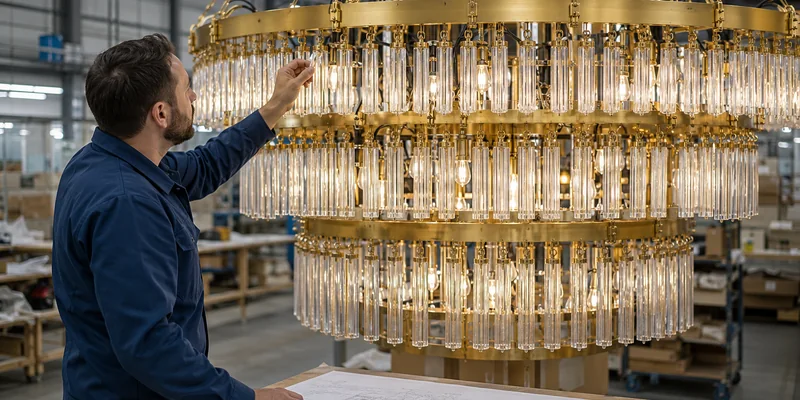
The factory offers level floors, controlled lighting, lifting equipment, jigs, tools and direct access to the people who made the fixture. If two modules do not align, the interface can be corrected before finishing or dispatch. If a suspension point makes the frame tilt, the balance can be reviewed. If the glass arrangement differs from the rendering, spacing can be adjusted while replacement parts are available. For how individual glass and crystal pieces are arranged in the finished fixture, see how glass and crystal pieces are arranged in a custom chandelier.
Finding the same problem after lifts or scaffolding have been installed in a finished hotel lobby is slower and more disruptive. Factory pre-assembly also creates a measurable reference for final quality control. Approved photographs, dimensions and test results allow the completed large chandelier installation to be compared with a known physical standard, not only with a concept rendering.
Limits of Full Factory Assembly for Large Chandeliers
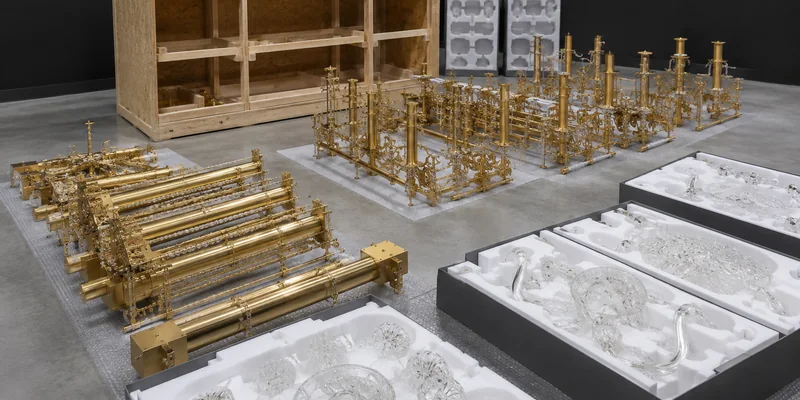
Complete factory assembly is not always the safest or most informative option. A chandelier can be wider than the factory doorway, truck, container, hotel entrance or service lift. A fully assembled frame may also flex during transport because it is supported differently from its final ceiling suspension.
Glass and crystal create another limitation. When hundreds of pieces remain attached during shipping, vibration can make them strike one another or the metalwork. The factory ceiling may also be too low to reproduce a 10- or 12-metre installation, and factory viewpoints may not match the lobby entrance, staircase or mezzanine. Full trial assembly should therefore be selected because it resolves risk, not merely because it produces an impressive photograph. For how finish standards are held consistent during production, see hotel lighting finish consistency control.
When Partial Chandelier Pre-Assembly Is the Better Choice

Partial chandelier pre-assembly is appropriate when the complete fixture is too tall, wide or fragile to assemble safely. The manufacturer can instead test the highest-risk interfaces: one canopy section, two adjoining frame modules, the longest suspension, one electrical circuit, a curved joint or a full-size decorative cluster.
For repeated modules, one approved section may establish the standard for the remaining production. Free-form structures usually need more adjoining modules because every interface can differ. The inspection record should identify which sections were fitted, which dimensions were checked and which conditions remain for the site team to verify.
Why On-Site Assembly Is Necessary for Custom Hotel Lighting
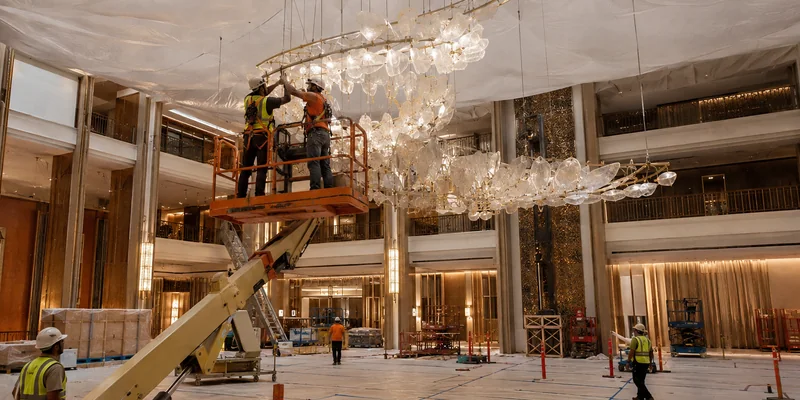
The final building conditions cannot be reproduced completely in a chandelier factory. Custom hotel lighting installation must work with the actual support structure, ceiling finish, power location, control system, access route, storage area and surrounding interior work. For coordinated deliveries at property scale, see Cuslux large hotel projects.
At the hotel, the team normally receives and checks the crates, confirms the support and electrical isolation, installs the canopy or primary frame, lifts and joins the modules, completes wiring and safety connections, levels the structure, installs numbered suspension components and finally hangs the glass or crystal. Lighting, dimming, alignment and cleaning are completed only after the chandelier is in its real environment.
What Chandelier On-Site Assembly Must Not Improvise
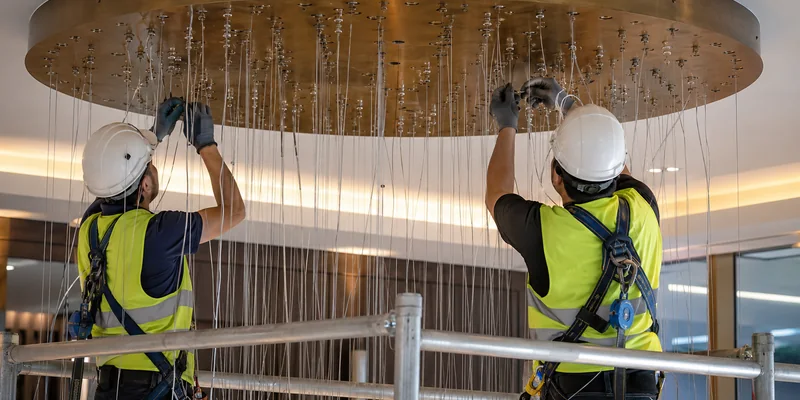
Although final assembly happens at the project, it should not become a second design process. Installers should not decide module order, cable lengths, decorative density or structural connection points by eye. Those decisions should already be controlled by approved drawings and factory records.
The chandelier on-site assembly package should include final shop drawings, canopy and suspension plans, module details, cable schedules, electrical diagrams, packing lists, numbering plans, lifting instructions, factory trial photographs and an inspection checklist. If the site differs from the approved information, the team should document the condition and obtain technical review before drilling new holes, cutting modules or changing a connection.
Factory Pre-Assembly vs On-Site Large Chandelier Assembly
| Comparison item | Factory pre-assembly | On-site assembly |
|---|---|---|
| Main objective | Verify manufacturability and assembly standard | Complete the installation in the actual building |
| Best use | Fit, alignment, wiring, balance and QC | Ceiling fixing, lifting, leveling and final decoration |
| Structural check | Fixture modules and interfaces | Building support and final suspension |
| Visual check | Finish, spacing and representative appearance | Final scale, sightlines and architectural relationship |
| Electrical work | Continuity, LED, driver and connector tests | Power, controls, dimming and commissioning |
| Main limitation | Cannot reproduce every site condition | Corrections are slower and more disruptive |
| Required evidence | Trial-assembly inspection record | Installation and commissioning record |
Neither stage provides complete control alone. The assembly plan should assign every check to the environment where it can be performed most accurately and safely.
How a Modular Chandelier Connects Factory and Site Assembly
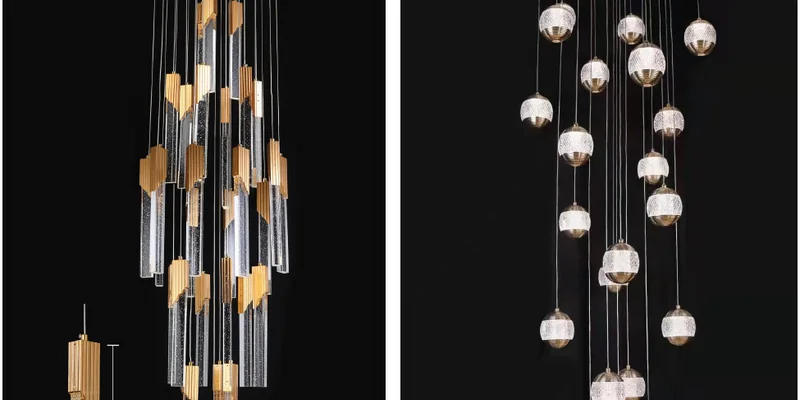
A modular chandelier is designed to be verified at the factory, separated for transport and rebuilt without losing its intended geometry. Engineers decide where the fixture can divide, how adjoining sections locate, where connectors sit and how installers identify every module. For how these modules are protected for overseas shipping, see how large custom chandeliers are packed for export.
Connections may use locating pins, sleeves, flanges, bolted plates or concealed internal joints. The method must control position and angle rather than asking installers to align a long curve visually. Adjacent wave, ring or free-form modules should be trial fitted and packed in sequence. Their codes must remain identical across shop drawings, factory inspection, crate labels and installation plans.
The dismantling method after the factory trial matters as much as the initial fit. Temporary reference marks should remain visible after protective wrapping, matched fasteners should stay with their modules, and vulnerable finished edges should be isolated before a section enters its crate. If trial-fitted parts are mixed during packing, the site crew loses much of the value created by pre-assembly. The packing plan should therefore follow the same module hierarchy used by engineering and installation.
How Custom Chandelier Numbering Preserves the Design
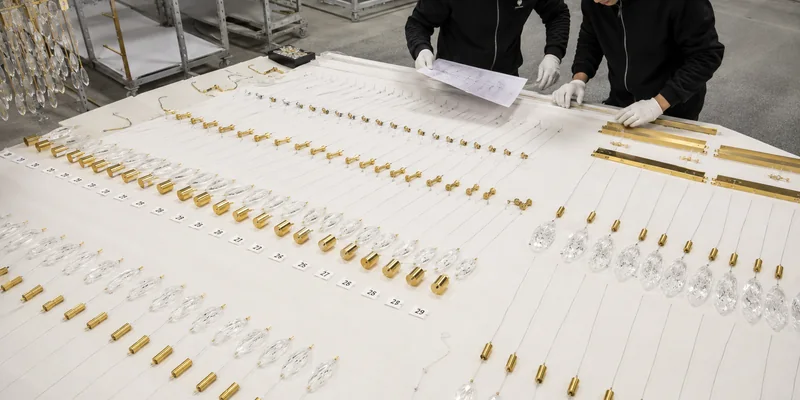
Large installations contain parts that look similar but are not interchangeable. Suspension cables may differ by a few centimetres, glass pieces may follow a controlled color mix, and curved modules may connect in only one direction. One numbering system should link the fixture area, frame module, suspension point, cable length, decorative part, carton and final position.
The same code must appear on the production drawing, component tag, packing list and installation drawing. Numbering is what turns a complex custom chandelier design into a repeatable installation. Without it, the site team can only create an approximation of the approved composition.
How to Choose a Large Chandelier Assembly Strategy
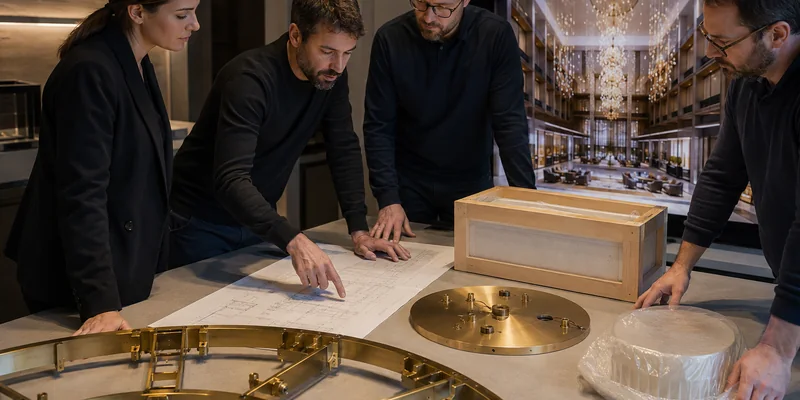
The strategy should be approved before production release. A full factory trial is valuable when the chandelier has a unique frame, difficult balance, visible module joints or integrated electrical systems. Partial pre-assembly may be enough when modules repeat. More site assembly is unavoidable when the fixture is extremely large, the route is restricted or fragile pieces must be installed after the frame is suspended.
The review should cover chandelier size and weight, factory height, module dimensions, container limits, hotel doors and lifts, ceiling readiness, lifting equipment, decorative quantity, site storage, crew experience, opening schedule and maintenance access. The outcome should be a responsibility matrix defining what the custom lighting manufacturer will test, what will ship separately and what the contractor will complete.
Before mobilizing the installation team, the project should also pass a site-readiness gate. The support structure, ceiling opening, access route, protected assembly area, power supply, dimming equipment, lift or scaffold, storage zone and approved work window should be confirmed in writing. Delivering a well-prepared modular chandelier to an unfinished or inaccessible area simply transfers risk from the factory to the site. Readiness confirmation allows the installation sequence and crate-opening plan to be coordinated with other trades.
Quality Control for Custom Chandelier Installation Handover
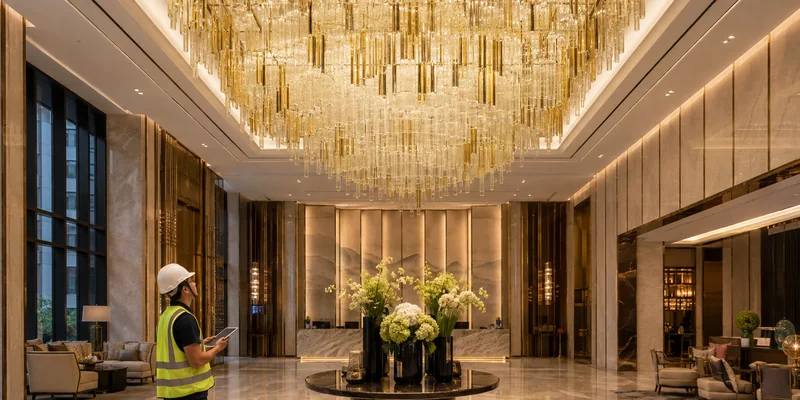
Factory and site teams should use the same acceptance standard. The factory record confirms dimensions, connections, alignment, finish, electrical operation, numbering and packing. Site inspection confirms suspension security, joints, level, decorative arrangement, wiring, dimming and final appearance. For how large fixtures are engineered for safe installation, see how large custom hotel chandeliers are engineered for safe installation.
A useful handover compares three references: approved shop drawings, the factory pre-assembly record and the completed installation. If they differ, the team can identify whether the cause is manufacturing, packing, site installation or changed building conditions. This is more useful than a general statement that the chandelier looks close to the rendering.
FAQ About Large Chandelier Assembly
Is factory pre-assembly required for every custom chandelier?
No. Small or straightforward fixtures may only need normal assembly and electrical inspection. Large, sculptural or modular chandeliers benefit more because their interfaces, balance and decorative arrangement carry greater project risk.
Can a large chandelier be shipped fully assembled?
Sometimes, but it is uncommon for atrium and ballroom fixtures. Transport dimensions, vibration, frame deformation and fragile materials usually make modular shipment safer.
Does chandelier pre-assembly reduce site installation time?
It can reduce site time by resolving fit, numbering and alignment issues before delivery. The benefit still depends on clear installation documents, logical packing and site readiness.
Who confirms the support for a large chandelier installation?
The manufacturer should provide fixture weight, suspension positions and proposed fixing information. The project architect, structural engineer or contractor should verify the building support and local conditions.
Should glass and crystal be fitted during factory pre-assembly?
They may be fitted temporarily to confirm density, color distribution and appearance, then removed and protected separately for overseas transport.
What if the site dimensions differ from the approved drawings?
The affected work should pause while the difference is documented and reviewed. Structural, suspension or module changes should not be improvised without approval.
Combine Factory Verification with Custom Chandelier Installation
The strongest result does not come from maximizing factory work or minimizing site work. It comes from assigning each activity to the environment where it can be controlled properly. Factory pre-assembly verifies fit, alignment, wiring, balance, finish, numbering and method. On-site assembly connects the chandelier to the real building and restores the approved composition.
Before manufacturing, review the custom hotel lighting pre-production checklist. For tall atriums, see how to customize a long chandelier for a hotel staircase or atrium. Buyers can also review how to avoid delays and quality issues when choosing custom lighting.
For an assembly review, provide the approved drawings, overall size and weight, proposed module divisions, transport route, site access dimensions, ceiling information and installation schedule. Cuslux can use these details to define the factory trial scope, module numbering, packing sequence and installation documents.