

Custom Pendant Lighting Project for a Modern Reception Desk

Zoey
Lighting Designer
Summary
A custom pendant lighting project should make a reception area more recognizable, comfortable, and aligned with the interior design. In this project, the product is a slim wave-shaped LED pendant installed above a modern front desk, where the lighting needed to support both visual identity and daily reception work.
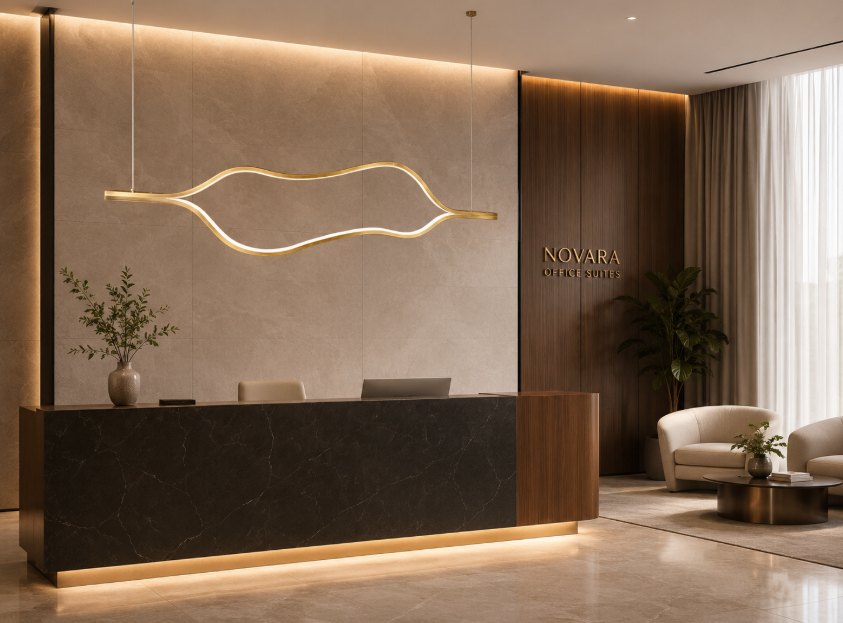
The pendant uses a soft curved outline, a continuous LED light line, and warm metal details to connect with the stone counter, wood wall panels, and calm neutral background. Instead of looking like a separate decorative lamp, the fixture becomes part of the reception desk composition.
Custom Pendant Lighting for a Modern Reception Desk
Custom pendant lighting is effective for a reception desk because the front desk is both a service point and a brand-facing area. Visitors usually notice the counter, background wall, and lighting first, so the pendant needs to create a clear visual focus without making the space feel crowded.
Why Does This Reception Area Need a Tailored Pendant Design?
This reception area needs a tailored pendant design because standard products may not match the desk width, wall proportion, or ceiling layout. A ready-made pendant can easily appear too short, too heavy, or visually disconnected from the front desk.
The wave-shaped form is designed to follow the horizontal direction of the counter while softening the straight architectural lines. This helps the reception zone feel more intentional and more welcoming.
How Does a Wave-Shaped Custom Pendant Light Improve First Impressions?
A wave-shaped custom pendant light improves first impressions by adding movement to an otherwise calm and linear space. The curved luminous line contrasts with the straight stone desk, wall panels, and ceiling tracks, making the front desk easier to notice.
The warm light also creates a more approachable atmosphere. For offices, hotels, sales centers, clinics, and showrooms, this type of pendant can make the arrival experience feel more refined without becoming overly decorative.
Custom Light Pendants with Soft Curves and Linear LED Glow
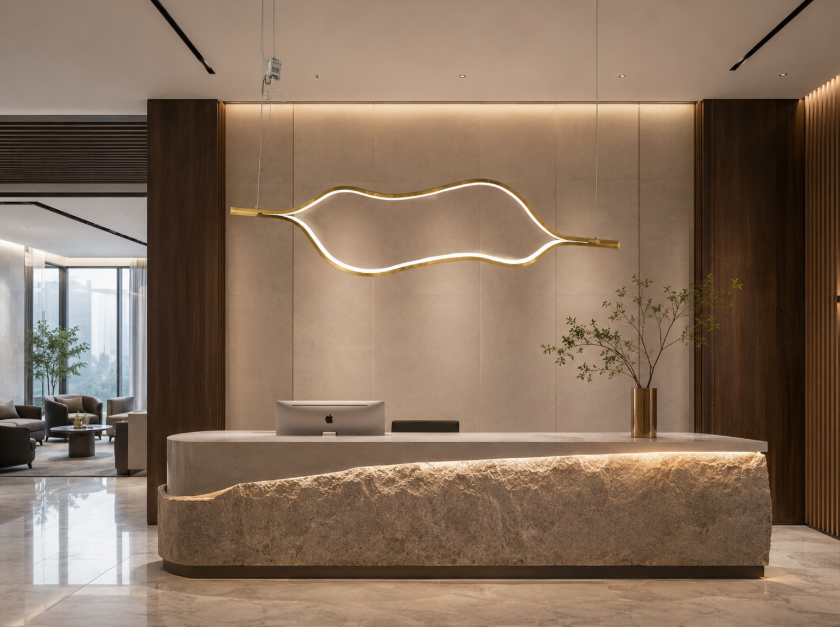
Custom light pendants with soft curves are suitable for modern commercial interiors because they combine simplicity with visual character. A curved linear pendant can look clean from a distance while still offering enough detail to make the space memorable.
Why Are Curved Pendant Forms Popular in Commercial Interiors?
Curved pendant forms are popular because they make modern interiors feel less rigid. Many commercial spaces use large flat walls, straight counters, linear ceiling details, and hard materials, so a soft curve helps create balance.
In this project, the pendant does not rely on complex decoration. Its main visual language comes from the flowing outline and continuous light, which makes it suitable for premium but restrained interiors.
How Do Warm LED Lines Make Front Desk Lighting More Welcoming?
Warm LED lines make front desk lighting more welcoming by reducing the cold feeling that can appear in highly modern spaces. A soft linear glow above the counter helps visitors feel guided and comfortable when approaching the reception area.
The light also works with the wood and stone materials in the room. This creates a more unified atmosphere instead of a fixture that feels added after the interior design was finished.
Custom Made Pendant Lights Planned Around Counter Proportion
Custom made pendant lights are valuable because the fixture size can be developed according to the actual counter length, ceiling height, and background wall scale. For a reception desk, proportion is one of the most important design factors.
How Should the Pendant Length Match the Reception Counter?
The pendant length should match the main service area of the reception counter rather than blindly covering the entire desk. A well-balanced pendant helps frame the working zone while leaving enough visual space on both sides.
If the pendant is too short, the desk may look unfinished. If it is too long, the fixture may compete with the architecture and make the ceiling feel crowded.
What Hanging Height Keeps Visitor Sightlines Comfortable?
The hanging height should keep the pendant visually connected to the counter while avoiding blocked sightlines. Staff and visitors need to communicate clearly, so the fixture should not interfere with eye contact, screens, signage, or front desk operation.
For similar projects, height should be checked together with ceiling structure and visitor viewpoint. A pendant that looks good in a rendering may need adjustment once real ceiling height and furniture dimensions are confirmed.
Custom Pendant Light Fixtures with Glare Control and Dimming Options
Custom pendant light fixtures should provide visual comfort, not only decorative value. In a reception area, lighting affects both visitors and staff, so glare control, brightness level, and color temperature should be considered early.
How Does a Diffused LED Strip Improve Visual Comfort?
A diffused LED strip improves visual comfort by hiding direct LED points and creating a continuous luminous surface. This helps reduce harsh brightness and makes the pendant easier to look at from different angles.
For a front desk, this detail is important because people often face the counter directly. A soft diffuser allows the pendant to remain visible and attractive without causing eye discomfort.
Why Should Dimming Be Considered for Reception Lighting?
Dimming should be considered because reception areas may need different light levels during daytime, evening, and special display scenes. A brighter setting can support daily work, while a softer setting can create a calmer atmosphere after dark.
For commercial projects, dimming also helps improve operational flexibility. When paired with suitable LED drivers and controls, the pendant can adapt to real use instead of staying at one fixed brightness.
Lighting Need | Reception Requirement | Pendant Response |
First impression | Clear visual focus | Wave-shaped luminous line |
Visitor comfort | Avoid harsh glare | Diffused LED strip |
Staff work | Support desk visibility | Balanced brightness |
Evening mood | Softer atmosphere | Dimming option |
Clean design | Match modern interiors | Slim profile |
Long-term use | Easier service | Planned driver access |
Best Custom Pendant Lights Material Choices for Similar Spaces
The best custom pendant lights are chosen according to the project style, lighting effect, maintenance needs, and installation conditions. For this reception desk, a slim metal body with a continuous diffuser is a practical and visually clean solution.
When Are Metal and Acrylic Suitable for Slim Linear Pendants?
Metal and acrylic are suitable when the project needs a stable structure and smooth LED diffusion. Metal provides strength and finish quality, while acrylic or a similar diffuser helps create a continuous light line.
This combination works well in modern reception areas because it looks clean, controlled, and easy to coordinate with stone, wood, and neutral wall finishes.
Can Custom Glass Pendant Lights Work for Reception Areas?
Custom glass pendant lights can work for reception areas when the design requires transparency, reflection, or a more decorative effect. Glass can add elegance and depth, especially in boutique hotels, restaurants, and luxury lounges.
However, glass may also require more attention to weight, cleaning, packaging, and installation. For this project, a metal-and-diffuser structure is more suitable because the space needs a slim architectural line above the counter.
Custom Fabric Pendant Light Alternatives for Softer Interiors
A custom fabric pendant light can be a good alternative when the project needs a warmer and more textured lighting expression. Fabric is not the best choice for every reception desk, but it can work well in hospitality spaces that want a softer and more relaxed atmosphere.
Where Are Custom Fabric Pendant Lights More Suitable?
Custom fabric pendant lights are more suitable for guest rooms, private lounges, boutique restaurants, spa reception areas, and relaxed hospitality interiors. Fabric can soften the light and bring a warmer decorative texture to the space.
Compared with the wave-shaped LED pendant in this project, fabric pendants usually feel less architectural and more intimate. This makes them useful when the goal is comfort rather than a sharp modern identity.
How Should Buyers Choose Between Fabric, Glass, and Metal?
Buyers should choose between fabric, glass, and metal according to the project’s design style, cleaning needs, lighting effect, and installation conditions. Metal is usually better for precise linear forms, glass is better for reflection and decoration, and fabric is better for softness and texture.
For a modern reception desk, metal with a diffuser often provides the best balance between clean appearance, easy maintenance, and comfortable light output.
Custom Pendant Lights from Drawing Review to Site Installation
Custom pendant lights should move through drawing review, material confirmation, production, testing, packing, and installation planning. This process helps reduce mistakes before the fixture reaches the project site.
What Production Details Should Be Confirmed Before Manufacturing?
Production details should include pendant length, curve shape, finish color, LED color temperature, brightness, dimming method, voltage, suspension cable position, driver location, and ceiling fixing points. These details directly affect the final appearance and installation result.
For a wave-shaped pendant, curve accuracy is especially important. If the line is too flat or too exaggerated, the fixture may lose the intended visual balance.
How Can Maintenance Be Planned Before the Pendant Is Installed?
Maintenance can be planned before installation by confirming driver access, replaceable LED components, wiring route, and service method. A fixture that looks simple may still require careful maintenance planning behind the ceiling or canopy.
For commercial reception areas, future downtime should be minimized. If service parts are accessible, the space can remain easier to manage after installation.
Custom Lighting Solutions for Your Space
Bring Your Lighting Design Concept to Life with CUSLUX
From chandeliers and pendant lights to decorative lighting for commercial and residential spaces, CUSLUX helps turn your ideas into custom lighting solutions with reliable design and production support.
Get Your Custom Lighting Solution →Buyer Checklist for a Custom Pendant Light Project
A custom pendant light project should be evaluated by proportion, lighting comfort, material quality, installation feasibility, and maintenance planning. Buyers should not judge the fixture only by a rendering or product photo.
What Should Buyers Ask Before Ordering a Reception Pendant?
Buyers should ask whether the size matches the counter, whether the light feels comfortable, whether the finish matches the interior, whether dimming is needed, and whether the pendant can be maintained later. These questions help avoid common project problems.
It is also useful to request drawings, finish samples, lighting test photos, and installation guidance. These materials make communication clearer between buyer, designer, contractor, and supplier.
How Can Suppliers Make Pendant Customization More Reliable?
Suppliers can make pendant customization more reliable by reviewing drawings, checking lighting performance, controlling finish quality, testing electrical parts, and preparing clear installation instructions. Reliability depends on process control as much as design appearance.
For this type of wave-shaped fixture, the supplier should pay attention to curve consistency, diffuser alignment, cable balance, surface treatment, and export packaging protection.
Buyer Concern | Why It Matters | What to Confirm |
Does it fit the counter? | Controls visual proportion | Length, height, and layout |
Is the light comfortable? | Affects staff and visitors | Diffuser, brightness, CCT |
Does the finish match? | Affects design quality | Metal sample and approval photo |
Can it be dimmed? | Supports different scenes | Driver and control compatibility |
Is installation clear? | Reduces site delays | Cable points and fixing method |
Can it be maintained? | Reduces long-term cost | Driver access and spare parts |
FAQ About Custom Pendant Lighting Projects
Custom pendant lighting projects often raise practical questions about application, material, size, and customization scope. These answers are written for buyers, designers, contractors, and commercial project owners.
1. Can This Pendant Be Used in Hotels, Offices, or Sales Centers?
This pendant can be used in hotels, offices, sales centers, clinics, beauty salons, showrooms, and other reception-style spaces. The wave form is distinctive but not overly decorative, so it can adapt to many modern interiors.
For hotels, the finish can be warmer and more luxurious. For offices, the design can be simplified with a cleaner metal tone and more neutral light output.
2. What Makes a Pendant Truly Custom?
A pendant becomes truly custom when its size, shape, finish, lighting effect, suspension method, and electrical configuration are adjusted for a specific project. Customization is not only changing color; it is making the product fit the actual space.
In this project, the wave outline, long horizontal scale, diffused LED line, warm metal details, and reception-desk proportion all make the pendant different from a standard catalog light.
3. How Do Buyers Choose the Right Pendant Material?
Buyers choose the right pendant material by matching the fixture with the project’s visual style, cleaning needs, durability requirements, and lighting effect. Metal is suitable for modern architectural lines, glass is suitable for decorative transparency, and fabric is suitable for soft hospitality moods.
For this reception space, metal and a continuous diffuser are more appropriate because they keep the fixture slim, clean, and practical for daily use.
4. What Is the Main Value of a Project-Specific Pendant?
The main value of a project-specific pendant is that the fixture can be designed around the real space. Length, height, curve, finish, LED output, and installation details can all be adjusted to match the reception desk.
This makes the pendant more integrated with the interior and more useful for long-term operation.