



Where to Buy Replacement Crystals for Chandeliers and How to Attach Them Correctly

Zoey
Lighting Designer
Quick Answer
If you need replacement Crystals for Chandeliers, start by identifying the crystal’s shape, length, hole style, and hanging method before you buy. In most cases, the safest route is to match one original piece by height first, then width, and confirm whether the top octagon, hook, pin, or clip is included.
Key Takeaways
Measure one original crystal before ordering.
Prioritize height match, then shape, hole type, and finish.
Confirm whether hooks, pins, or octagons are included.
Buy extra pieces for future chandelier repair.
Turn power off at the breaker before any handling.
Rehang crystals symmetrically to preserve balance and light distribution.
Avoid glue-first repairs unless the mounting design specifically allows it.
Use trusted lighting parts suppliers or specialist crystal retailers.
Abstract
Replacing missing or damaged chandelier pieces is easier when the process is systematic. This guide explains where to buy replacement chandelier crystals, how to choose the right size and style, how to attach crystals securely, and which chandelier repair mistakes to avoid. It also answers common search questions such as “Can you replace crystals on a chandelier?”, “How do I know which crystal shape I need?”, and “What is the best way to attach chandelier drops?” The goal is practical: help readers restore brilliance, maintain visual consistency, and avoid mismatched parts or unsafe installation steps.
Table of Contents
Where to Buy Replacement Crystals for Chandeliers
How to Choose the Right Replacement Chandelier Crystals
-Match shape, length, and hole type
- Compare crystal vs glass vs acrylic
-Decide whether to replace one piece or all
How to Attach Crystals to a Chandelier Correctly
-Tools and preparation
-Step-by-step attachment method
-How to keep the chandelier visually balanced
Common Chandelier Repair Mistakes to Avoid
Final Thoughts
Frequently Asked Questions About Crystals for Chandeliers
Where to Buy Replacement Crystals for Chandeliers
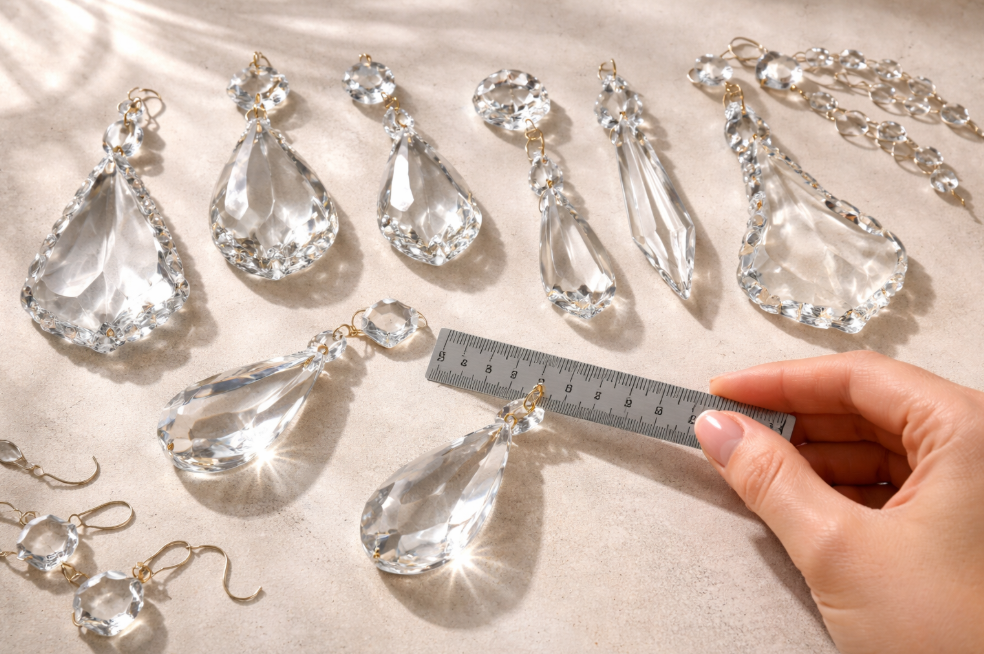
When people search for where to buy replacement crystals for chandeliers, they usually need one of four sources:
l specialist chandelier-parts stores
l antique lighting suppliers
l lighting retailers with replacement-parts support
l restoration-focused crystal shops
Industry suppliers commonly sell pendalogues, almonds, teardrops, spears, buttons, chains, and octagons. Octagons are among the most common chandelier bead forms, and 14 mm is often cited as a traditional popular size, though actual size depends on fixture style.
Recommended buying channels
Source type | Best for | Advantage | Watch out for |
Specialist crystal retailers | Exact-match crystal parts | More shape and pinning options | Returns may be limited |
Antique lamp/lighting suppliers | Vintage or period fixtures | Better for older profiles and finishes | Stock may vary |
Large lighting retailers | Standard replacement chandelier crystals | Easier browsing and customer service | Fewer restoration-grade variations |
Restoration experts | Rare or incomplete chandeliers | Help identifying unknown parts | Higher cost |
What to check before buying
Checklist item | Why it matters |
Crystal height | Many suppliers note height as the main matching dimension |
Width | Helps visual consistency, but is often secondary to length |
Top connector included or not | Listings may exclude the octagon/button in the measurement |
Pinning style | Hooked, clipped, wired, or pinned pieces install differently |
Material | Crystal, glass, and acrylic reflect light differently |
Finish color | Clear, smoke, amber, or colored pieces change the fixture look |
A practical buying rule is simple: order one test piece first when the chandelier model is unknown. Some restoration sellers also advise that if most drops are missing, replacing the full set may create a cleaner final look than mixing old and new components.
How to Choose the Right Replacement Chandelier Crystals
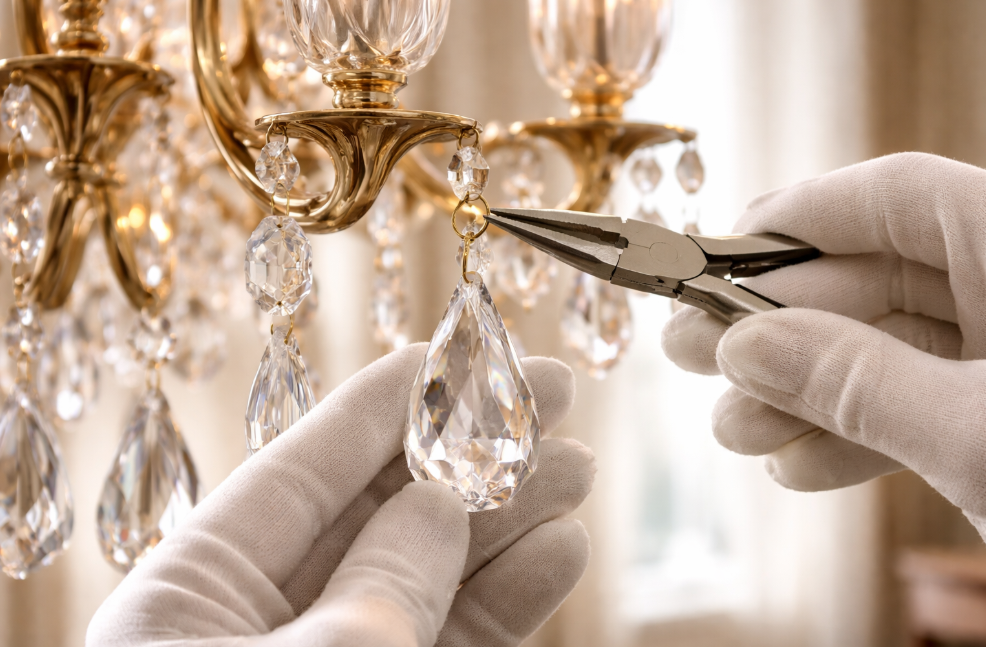
Choosing the right Crystals for Chandeliers is not just about shape. It is about proportion, attachment method, and optical consistency.
Match shape, length, and hole type
A reliable way to identify replacement chandelier crystals is to compare one existing piece. Measure the crystal body carefully and note whether the seller’s dimensions include the top connector. Some crystal suppliers state clearly that the listed length is measured without the upper octagon. Matching by height is often more important than matching by width because small width variations tend to blend in better visually.
Common shapes for Crystals for Chandeliers
Shape | Typical look | Best use |
Octagon | small 8-sided bead | chains, top connectors |
Teardrop | elegant pointed drop | classic chandeliers |
Almond | elongated oval | traditional fixtures |
Pendalogue | faceted shield-like drop | formal crystal chandeliers |
Icicle/Spear | long vertical accent | dramatic modern or grand fixtures |
Compare crystal vs glass vs acrylic
Not every chandelier uses premium cut crystal. Some fixtures use glass, and lower-cost models may use acrylic. Genuine crystal is usually heavier and shows stronger refraction and sparkle than acrylic alternatives, while glass can look cleaner than acrylic but may still offer less brilliance than high-quality optical crystal.
Quick selection matrix
Priority | Best choice |
Maximum sparkle | optical crystal |
Budget replacement | glass |
Lightweight fixture | acrylic or lighter glass |
Antique restoration | match original material first |
Mixed missing parts | replace a whole section for consistency |
Decide whether to replace one piece or all
A common Google-style question is: “Can you replace just one crystal on a chandelier?” Yes, but only when the remaining parts are still close in clarity, cut, and tone. If the chandelier is aged, yellowed, or missing many pieces, partial replacement can make new drops stand out too sharply. For older fixtures, replacing by ring, arm, or full side often creates a more even result.
How to Attach Crystals to a Chandelier Correctly
Tools and preparation
Before you begin, turn off power at the breaker. Electrical safety organizations warn that household electrical hazards can lead to fires and injuries, and lighting work should not be done on an energized fixture. Overloaded or faulty electrical systems are also a recognized residential fire risk.
Prepare:
l soft gloves or lint-free cloth
l ladder
l small container for pins and clips
l needle-nose pliers
l phone camera for reference photos
l replacement crystal parts
l optional labeling tape for sections
Lamps Plus advises photographing chandelier arrangements before removal and cleaning in sections rather than twisting the fixture, which can loosen supports.
Step-by-step attachment method
l Turn off power at the breaker.
l Photograph the chandelier from several angles.
l Remove one matching crystal from the same section if needed.
l Confirm the attachment style: hook, ring, wire, pin, or octagon chain.
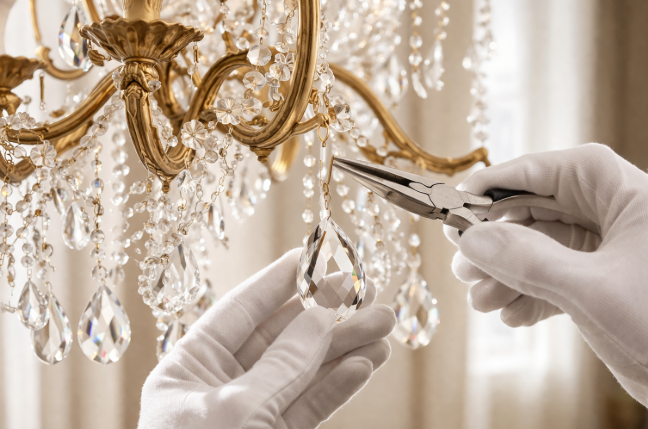
l Open the connector slightly with pliers rather than overbending it.
l Thread or hook the new crystal into the correct hole or top bead.
l Close the connector gently so the crystal hangs straight.
l Repeat symmetrically on the opposite side.
Basic attachment flow
Attachment style | How it usually works | Best practice |
Hook/ring | crystal hangs from metal loop | open minimally to avoid weakening metal |
Pinning | crystal linked by decorative pin | match finish and length exactly |
Octagon chain | bead-to-drop sequence | keep chain lengths even |
Clip mount | crystal sits in formed clip | verify clip tension before rehanging |
How to keep the chandelier visually balanced
A chandelier should be rehung in mirrored sections, not randomly. Replace left and right sides together, then step back and check spacing, height, and symmetry. This matters because chandeliers are decorative light sources; imbalance is visible even from a distance. If the chandelier hangs above a dining table, size and proportional balance are especially important in the overall visual composition. Lamps Plus notes that chandeliers are chosen and judged heavily by proportion and hanging placement, which supports the idea that crystal arrangement should also stay visually consistent.
Common Chandelier Repair Mistakes to Avoid
Mistake 1: Ordering by photo alone
A photo helps, but dimensions matter more. Always measure.
Mistake 2: Ignoring connector details
Many buyers match the drop shape but forget the hook, pin, top bead, or hole diameter.
Mistake 3: Mixing too many crystal grades
High-clarity pieces beside duller parts can make the chandelier look patched rather than restored.
Mistake 4: Replacing only the most visible pieces
If one front section is brighter than the rest, the whole fixture can look uneven.
Mistake 5: Twisting the chandelier while working
Cleaning and repair guides caution against rotating the chandelier because that can loosen support hardware.
Mistake 6: Working with power still on
This is the most important safety error. De-energize first.
Final Thoughts
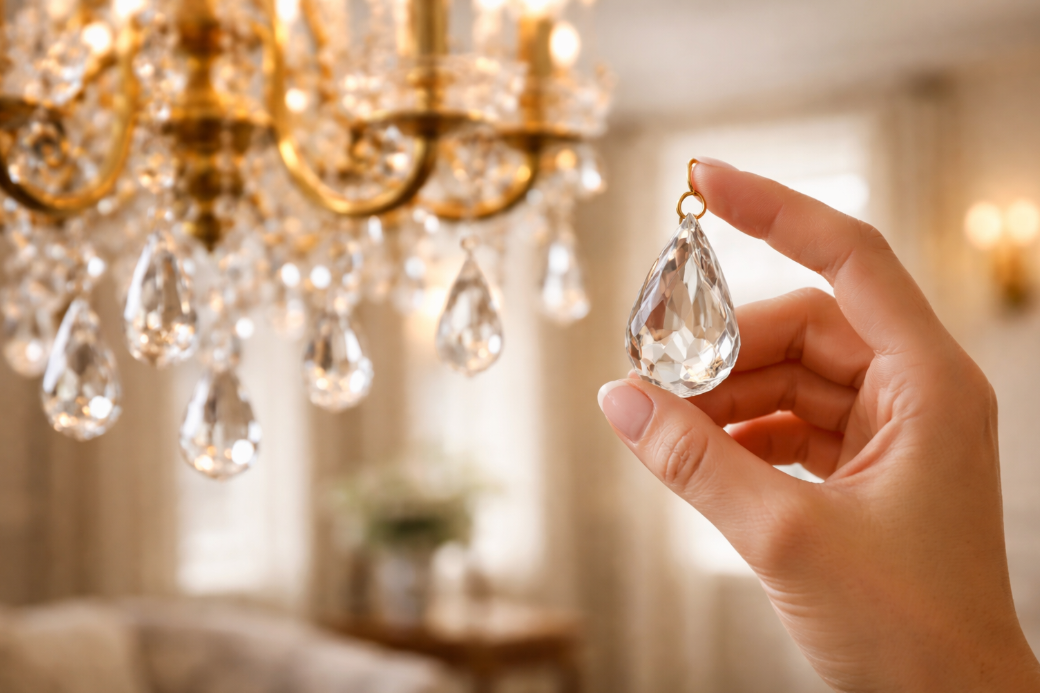
The best results with Crystals for Chandeliers come from careful matching, not rushed buying. A successful repair usually depends on four things: accurate measurement, the right connector style, balanced reinstallation, and safe handling. For most readers, the smartest workflow is to identify one original crystal, order a test replacement, then rebuild the chandelier section by section. That approach keeps the fixture elegant, practical, and visually consistent without turning a small repair into a full restoration.
Frequently Asked Questions About Crystals for Chandeliers
1.Can you replace crystals on a chandelier?
Yes. In most cases, individual drops, chains, and octagons can be replaced if you match the size, shape, and hanging method correctly.
2.How do I know which Crystals for Chandeliers I need?
Measure one original piece, identify its shape, and check whether the seller’s listed size includes the connector. Height is often the first matching priority.
3。What are the most common chandelier crystal replacements?
Octagons, pendalogues, almonds, teardrops, and crystal chains are among the most common replacement forms.
4.Is it better to buy crystal or glass?
For maximum brilliance, crystal is usually preferred. For budget-friendly chandelier repair, glass can be a practical alternative.
5.Should I replace all the crystals at once?
Only if many are missing, discolored, or badly mismatched. Otherwise, a well-matched partial repair is often enough.