
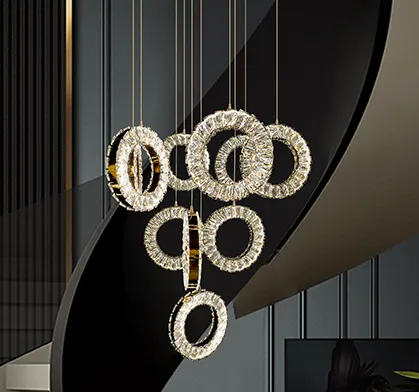



Crystal Chandelier Guide: How to Choose the Right Modern, Vintage, or Black Crystal Chandelier

Zoey
Lighting Designer
Summary
A crystal chandelier can elevate a room, but the best choice is rarely the most decorative one. In most homes, the real issues are scale, placement, and fit: the fixture is too small for the room, too wide for the table, too low for sightlines, or too ornate for the surrounding furniture.
A better approach is to choose in this order: style first, shape second, size third, and hanging height last. That sequence is practical because it helps narrow options without relying on guesswork. Widely used lighting guidance suggests starting chandelier diameter with room dimensions, sizing dining fixtures in proportion to the table, and hanging most dining chandeliers about 30 to 36 inches above the tabletop. In open spaces, designers generally keep at least 7 feet of floor clearance.
This guide is written for real buying decisions. Whether you are comparing a modern crystal chandelier, a vintage crystal chandelier, a black crystal chandelier, or a lighter option for a softer interior, the goal is simple: choose a fixture that looks right, works well, and will still feel right a year from now.
Contents
-Why a Crystal Chandelier Still Makes Sense
- Start With Style: Modern, Vintage, Black, or White
Modern Crystal Chandelier
Vintage Crystal Chandelier
Black Crystal Chandelier
White Crystal Chandelier
- Then Choose the Right Shape: Round, Rectangular, or Linear
Round Crystal Chandelier
Rectangular Crystal Chandelier
Linear Crystal Chandelier
- Use Practical Sizing Rules Instead of Guesswork
Room-Based Sizing
Table-Based Sizing
Hanging Height
- Room-by-Room Buying Advice
- Common Mistakes to Avoid
-Final Thoughts
Why a Crystal Chandelier Still Makes Sense
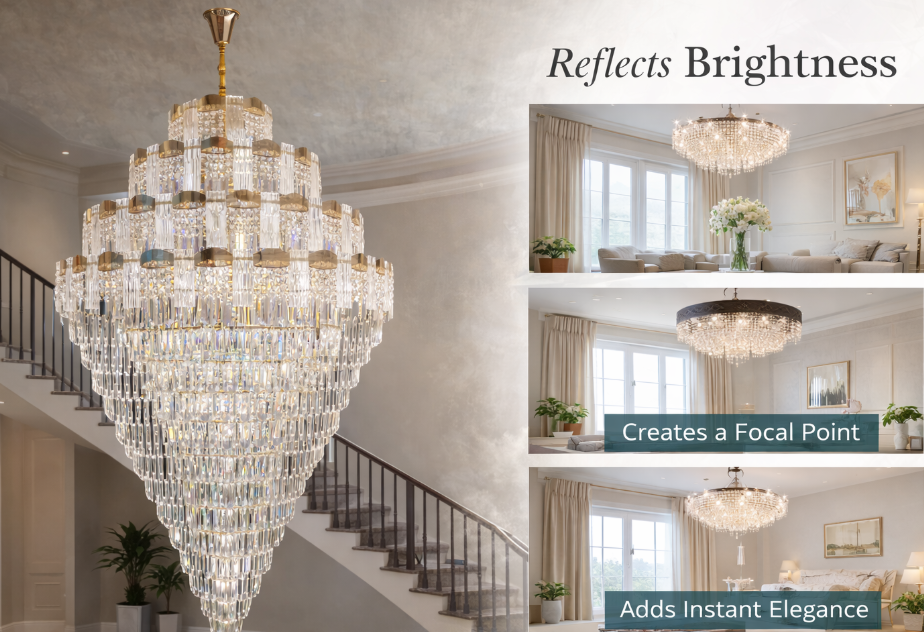
The Crystal Chandelier has stayed relevant because it does more than provide light. It adds texture, reflects brightness across the room, and creates a clear focal point. Architectural Digest describes chandeliers as the “jewelry” of a room, which is a useful way to think about them: they are not just functional, they complete the visual composition. At the same time, crystal is no longer limited to formal or traditional interiors. Current examples range from classic tiered pieces to slim, contemporary fixtures with cleaner lines.
For most buyers, the value of a crystal chandelier comes down to three things:
l it improves ambient light by reflecting it
l it anchors the center of the room
l it adds detail without requiring major renovation
That is why crystal still works in dining rooms, foyers, bedrooms, and even some kitchen layouts.
Start With Style: Modern, Vintage, Black, or White
Style should be your first filter because it determines how visually heavy the chandelier will feel. Two fixtures can have the same width but look completely different in a room depending on frame finish, crystal density, and silhouette.
Style | Best for | Overall effect | Best match |
modern crystal chandelier | Contemporary homes, apartments, open-plan dining rooms | Clean, refined, architectural | Minimalist or transitional interiors |
vintage crystal chandelier | Traditional dining rooms, classic bedrooms, formal entryways | Warm, layered, timeless | Rooms with molding, wood tones, or antique finishes |
black crystal chandelier | Contrast-heavy interiors, modern farmhouse, transitional spaces | Bold, defined, dramatic | Rooms with black hardware or darker accents |
white crystal chandelier | Bright bedrooms, coastal homes, soft neutral interiors | Airy, calm, understated | Light palettes and low-contrast rooms |
Modern Crystal Chandelier
A modern crystal chandelier is usually the easiest to place because it balances sparkle with restraint. Instead of elaborate arms and dense crystal draping, it often uses simpler geometry, slimmer frames, or ring and bar forms.
It works especially well when the room already has:
l straight furniture lines
l a neutral palette
l a cleaner architectural look
l fewer decorative details elsewhere
In practical terms, this is often the safest choice for a buyer who wants crystal without making the room feel formal.
Vintage Crystal Chandelier
A vintage crystal chandelier has more decorative weight. It often includes curved arms, candle-style bulbs, antique brass or bronze finishes, and more visible crystal layering.
It is most effective in spaces that already have:
l classic millwork
l darker wood furniture
l soft traditional textiles
l a more formal dining or bedroom setup
Better Homes & Gardens notes that vintage fixtures require extra attention to wiring, condition, and maintenance when buying genuine older pieces, which makes this style beautiful but slightly less carefree in daily use.
Black Crystal Chandelier
A black crystal chandelier works well when a room needs contrast. The dark frame gives the fixture more outline and structure, while the crystal prevents it from feeling flat.
This option tends to perform best in:
l transitional interiors
l modern farmhouse spaces
l rooms with dark hardware
l homes using black window frames or furniture accents
Compared with lighter designs, a black fixture reads as more graphic and intentional.
White Crystal Chandelier
A white crystal chandelier is useful when you want elegance without visual heaviness. It blends more easily into pale ceilings and soft wall colors, which can help smaller rooms feel more open.
It is a good fit for:
l light bedrooms
l coastal or soft-modern interiors
l small dining rooms
l homes with white, cream, or pale gray palettes
If the room already feels delicate and bright, this style usually integrates more naturally than a darker fixture.
Then Choose the Right Shape: Round, Rectangular, or Linear
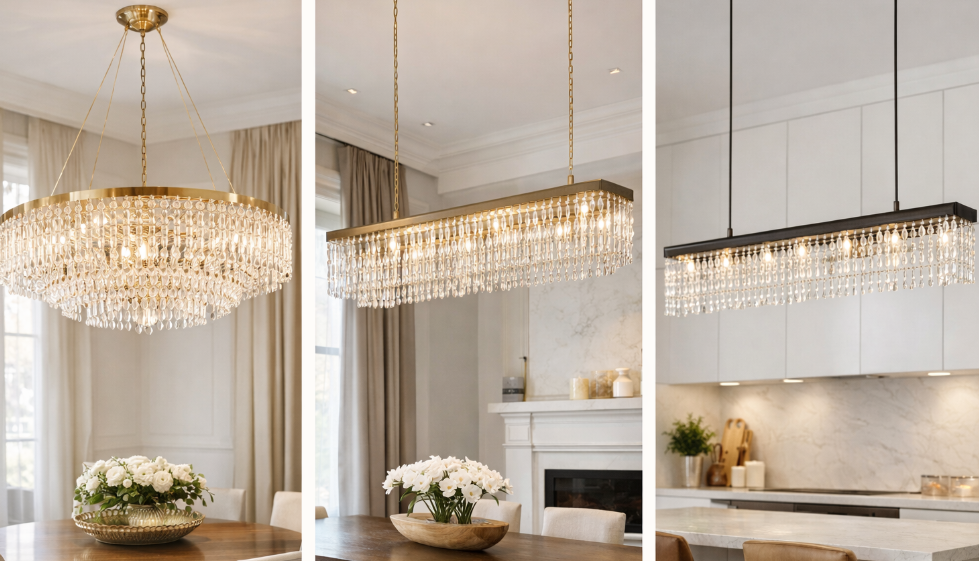
Once style is clear, shape should follow the furniture or layout below it. This is one of the most practical design rules because the wrong shape can make even a beautiful chandelier feel awkward. Kelly Wearstler’s guidance highlighted by Architectural Digest specifically favors linear chandeliers for narrow spaces, while HGTV and House Beautiful both emphasize proportion to the table.
Shape | Best placement | Main strength |
round crystal chandelier | Round tables, foyers, bedrooms | Balanced, centered appearance |
rectangular crystal chandelier | Long dining tables, larger rooms | Better visual coverage across the table |
linear crystal chandelier | Kitchen islands, narrow tables, open layouts | Clean profile and even light spread |
Round Crystal Chandelier
A round crystal chandelier is the most versatile option. It creates a clear center point and works especially well in symmetrical spaces.
Best uses:
l round dining tables
l square breakfast areas
l bedrooms
l entryways
This shape is often the easiest choice when you want something timeless and visually balanced.
Rectangular Crystal Chandelier
A rectangular crystal chandelier is better suited to long tables because it follows the proportions below it. It also tends to distribute light more evenly across a larger dining surface.
Best uses:
l 6- to 10-seat dining tables
l formal dining rooms
l open-plan dining areas with long sightlines
If a centered round fixture leaves the ends of the table feeling visually empty, rectangular is usually the better answer.
Linear Crystal Chandelier
A linear crystal chandelier works best where the surface below is long and narrow. That is why it is so common above kitchen islands and slim dining tables.
Best uses:
l kitchen islands
l bar-height counters
l narrow dining tables
l contemporary open layouts
Because the profile is usually slimmer, this shape often feels more practical in everyday spaces.
Use Practical Sizing Rules Instead of Guesswork
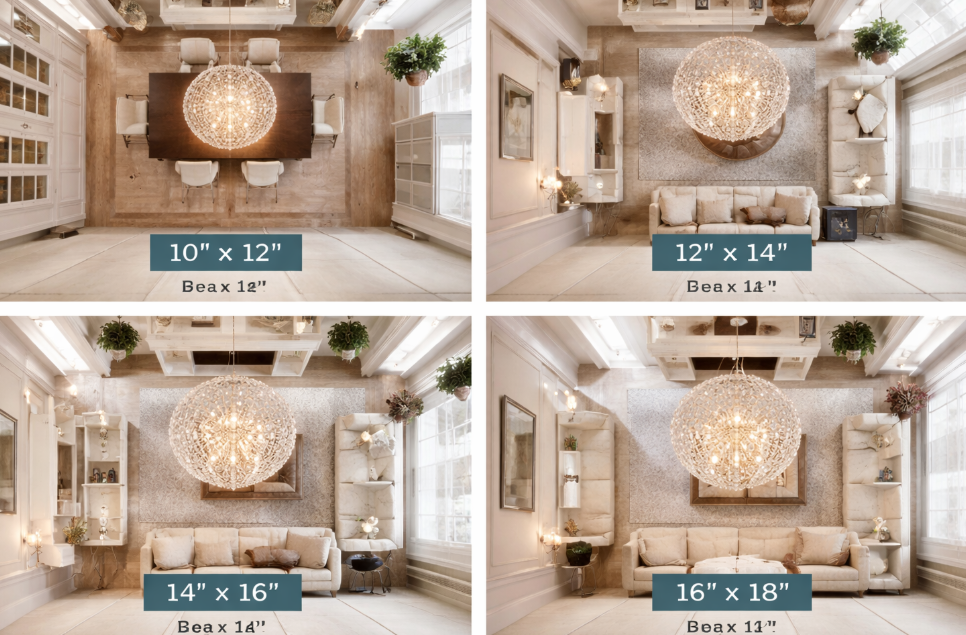
Sizing is where most chandelier purchases go wrong. A practical method is to start with a rule, then adjust slightly for ceiling height and design weight.
Room-Based Sizing
A common starting rule is to add the room’s length and width in feet, then use that total in inches as an approximate chandelier diameter. Architectural Digest and House Beautiful both present this as a useful baseline, especially for central fixtures in living or dining rooms.
Room size | Starting chandelier diameter |
10' × 12' | about 22" |
12' × 14' | about 26" |
14' × 16' | about 30" |
16' × 18' | about 34" |
This method is not exact, but it prevents the most common problem: choosing a fixture that is too small to anchor the room.
Table-Based Sizing
For dining areas, table size matters more than room size. HGTV offers a conservative rule of about one-third the table width, while House Beautiful suggests a stronger visual range of about one-half to two-thirds the table width. Read together, these are less contradictory than they seem: one-third is a safer minimum, while one-half to two-thirds creates a more intentional statement.
Table width | Safe starting range | Stronger statement range |
36" | 12"–18" | 18"–24" |
42" | 14"–21" | 21"–28" |
48" | 16"–24" | 24"–32" |
54" | 18"–27" | 27"–36" |
60" | 20"–30" | 30"–40" |
Use the smaller end of the range if the chandelier is dense or ornate. Use the larger end if the frame is open and visually light.
(h3) Hanging Height
For most dining rooms, the bottom of the chandelier should sit about 30 to 36 inches above the tabletop. In open areas, designers usually maintain at least 7 feet of clearance from the floor. These are the most repeated placement rules across AD and HGTV guidance.
Placement | Recommended height |
Over dining table | 30"–36" above tabletop |
Open room or walkway | At least 7' from floor |
Tall foyer | Higher placement, scaled to ceiling height |
Bedroom | High enough to avoid visual crowding |
The common mistake is hanging a dining chandelier too high. In real rooms, a lower fixture usually feels better connected to the table and gives the space more atmosphere. HGTV explicitly warns that height and centering matter as much as the fixture itself.
Room-by-Room Buying Advice
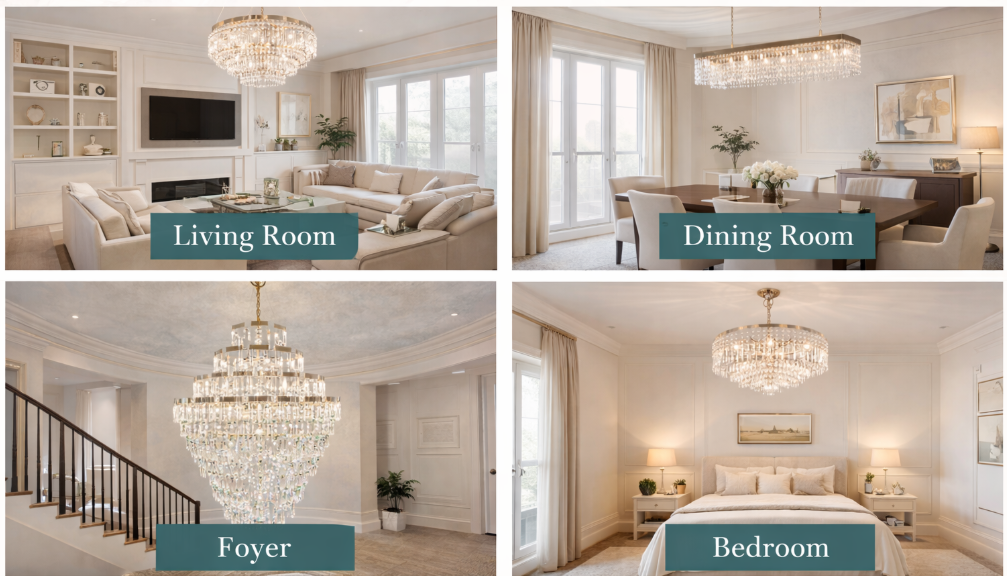
1.Dining room
This is still the most natural place for a crystal chandelier. Start with the table shape, then confirm size, then set the hanging height. The Spruce also recommends keeping around 3 feet of clearance around the dining table in the room overall, which helps explain why oversized fixtures can make tight dining spaces feel crowded.
2.Living room
In a living room, the chandelier should relate to the seating zone rather than the whole floor plan. A modern crystal chandelier or black crystal chandelier often works best here because the look stays polished without becoming too formal.
3.Bedroom
Bedrooms benefit from softer visual weight. A white crystal chandelier or a lighter vintage crystal chandelier often works better than a large, high-contrast fixture. Warm dimmable lighting also matters here; Southern Living highlights dimmers and warm LED temperatures around 2700K as a preferred choice for a comfortable glow.
4.Entryway
An entryway can carry more drama, especially with taller ceilings. This is where a Crystal Chandelier can create a real first impression, but only if the scale matches the height of the space.
5.Kitchen island
A linear crystal chandelier is usually the most practical choice here because it follows the shape of the island and keeps sightlines cleaner.
Common Mistakes to Avoid
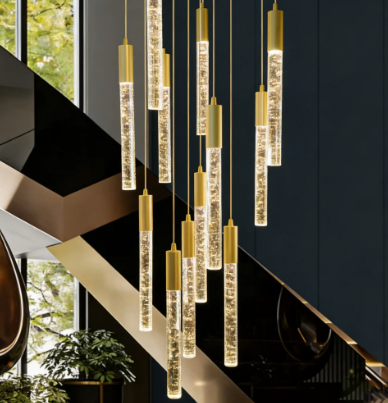
The same problems show up again and again in chandelier selection:
1.Buying by photo instead of dimensions.
2.Matching the fixture to the room but not the table.
3.Hanging it too high above a dining surface.
4.Choosing a very ornate design for a visually simple room with no supporting detail.
5.Relying only on overhead lighting instead of layering with lamps, sconces, or dimmers. Southern Living specifically notes that overhead-only lighting tends to create flatter, less comfortable rooms.
A chandelier should feel integrated, not just impressive on its own.
Final Thoughts
Thebest crystal chandelier is not the one with the most sparkle. It is the one that suits the room’s scale, shape, and mood. A modern crystal chandelier feels cleaner and easier to place. A vintage crystal chandelier adds warmth and character. A black crystal chandelier introduces contrast. A white crystal chandelier keeps the room lighter and softer.
If you choose in the right order—style, shape, size, and height—you avoid most of the common mistakes before they happen. That makes the decision simpler, and usually leads to a fixture that feels right long after installation.